 |
Subscribe / Renew |
 |
Contact Us |
| ► Subscribe to our Free Weekly Newsletter | |

Construction Bids
| home | Welcome, sign in or click here to subscribe. | login |


 print print  email to a friend email to a friend  reprints add to mydjc reprints add to mydjc |  |
 |
June 25, 2026

Hearn
|

McBride
|
Two-thirds of college students report feeling lonely. Three in ten 10 report severe psychological distress. More than four in five students who faced mental health challenges in the past year doubt their ability to graduate on time. These are not abstract statistics — they describe the lived reality on our campuses right now.
There is hope: the 2024—2025 Healthy Minds Study shows depression, anxiety and loneliness declining for the third consecutive year. The data make one thing clear:, creating a sense of belonging on campus is a necessity, and the physical environment is one of the most powerful tools we have to foster it.
WHY BELONGING MATTERS
Belonging for college students includes students’ perceived social support on campus, a feeling of connectedness and the experience of mattering (Strayhorn, 2018). Research shows that what drives belonging are positive interpersonal interactions with diverse peers and feelings of safety and inclusion. The outcomes are significant: stronger identity, improved mental health, academic success, and resilience.
Students who feel they belong do better in every measurable way. For example, the University of Oregon reports that full time first-year students who live on campus have higher GPAs, higher retention rates, higher graduation rates, and faster graduation times. Another study affirms the importance of belonging also applies to the design of academic buildings, where learning environments and informal gathering spaces can support the formation of a professional identify and foster academic success through social connections.
DESIGN TOOLS FOR INCLUSION AND BELONGING
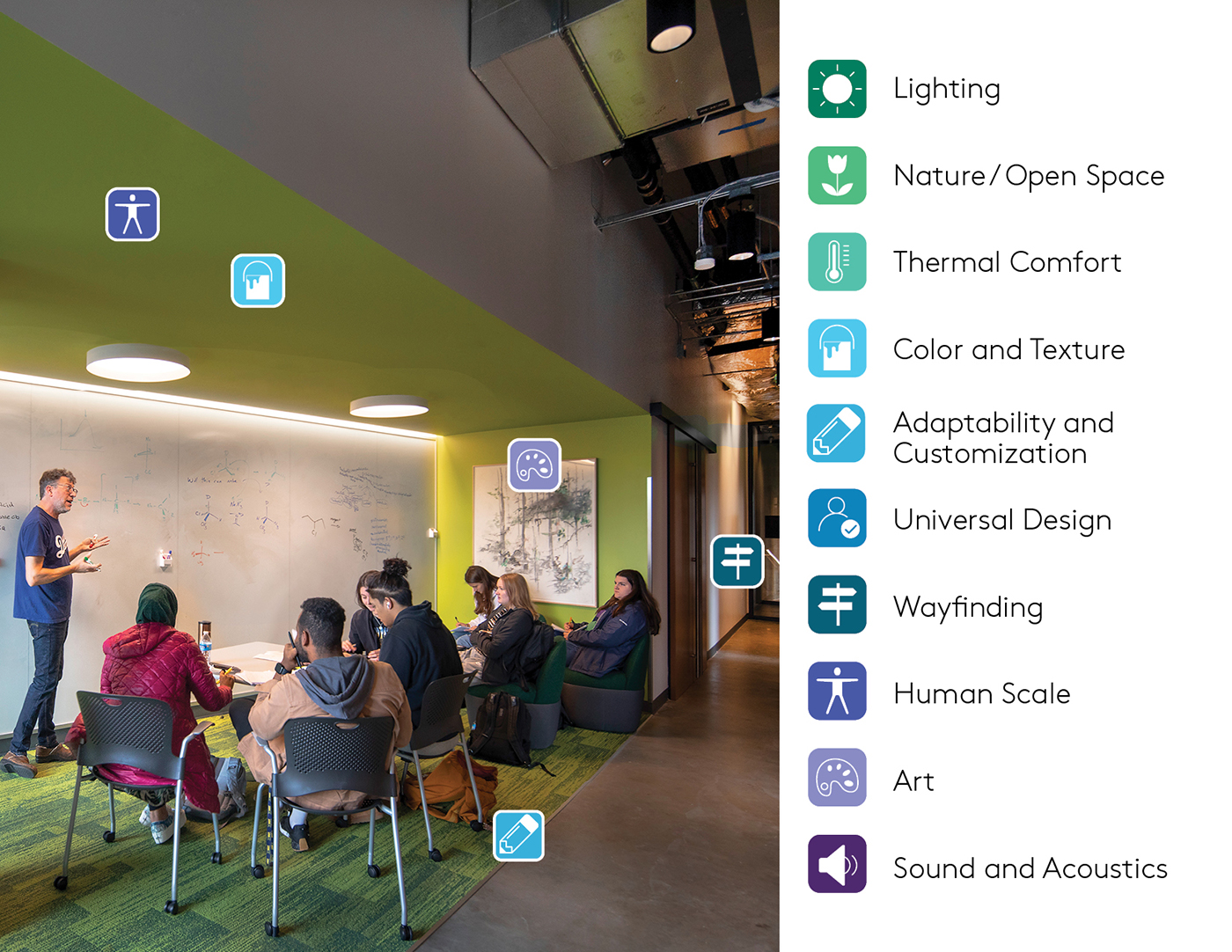
Mithun’s Design for Health initiative has combined practice and research since 2009. Through literature review, research and development and direct engagement with students at campuses including UC Irvine, Georgia Tech and UC Santa Barbara and the University of Washington, we have identified ten research-supported design factors for belonging:
LIGHTING — affects mood, productivity and engagement; students are drawn to spaces that feel warm and home-like
SOUND AND ACOUSTICS — noise control enhances concentration and reduces stress
THERMAL COMFORT — comfortable temperatures support focus and emotional regulation
COLOR AND TEXTURE — create inviting environments and can celebrate school or hall identity
ADAPTABILITY AND CUSTOMIZATION — adjustable furniture, tackable surfaces and flexible layouts give students autonomy
HUMAN SCALE — approachable, relatable spaces promote comfort and community
ART — artwork in communal areas signals inclusion and sparks connection
NATURE AND OPEN SPACE — green areas and outdoor gathering spaces support mental wellbeing
WAYFINDING — clear navigation helps students feel oriented and encourages access to community spaces
UNIVERSAL DESIGN — goes beyond ADA compliance to signal that all bodies and identities are welcome
These are universal elements, but they must be fine-tuned to specific populations through surveys, focus groups, interviews and observational studies.
PUTTING RESEARCH INTO PRACTICE
At UC Irvine Mesa Court Towers, a post-occupancy evaluation found that 65 percent of residents have spontaneous conversations in common spaces multiple times per week. When asked which community they felt most connected to, 44.8 percent chose their hall or residential community — more than clubs, academics or athletics. When design prioritizes connection, students engage.
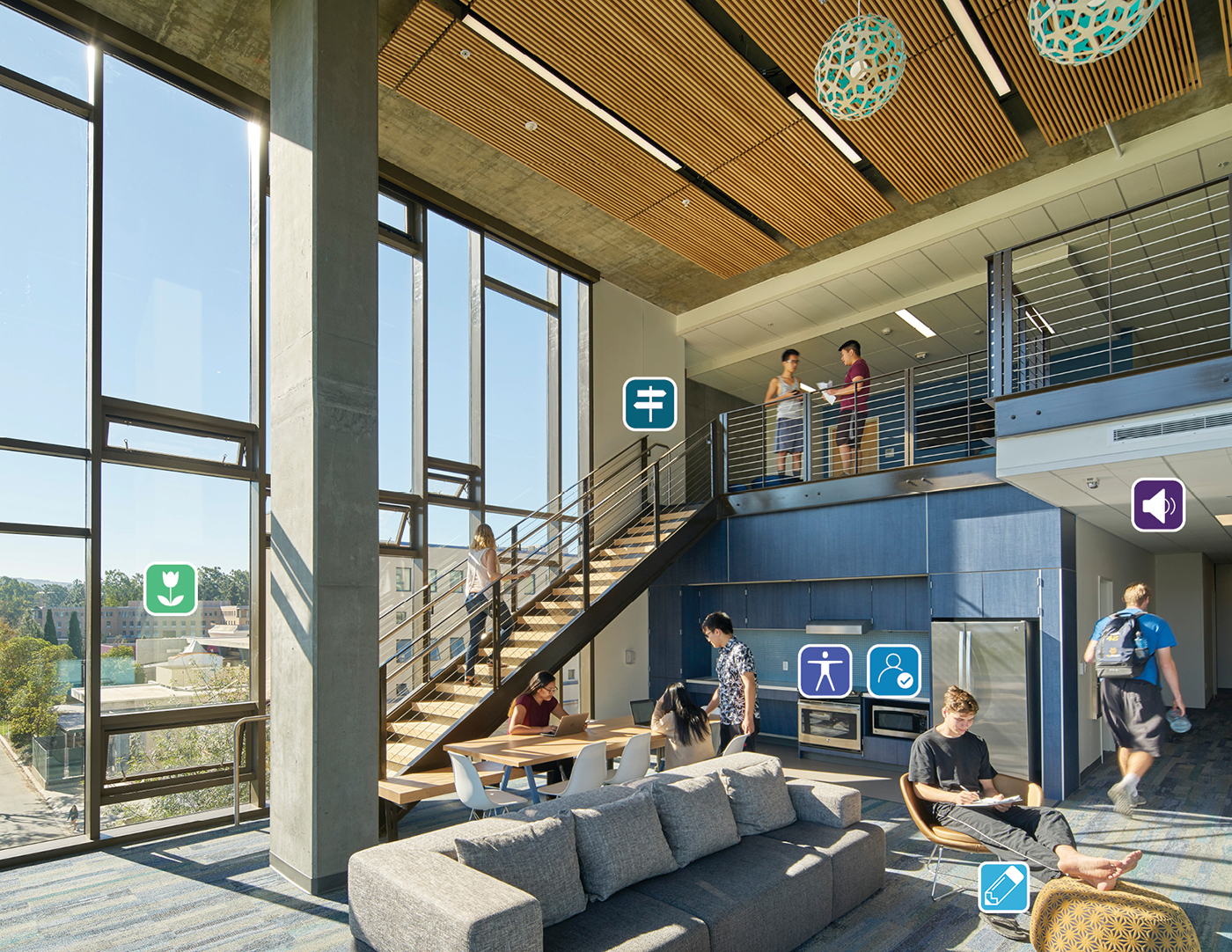
We applied these findings to the adjacent Oso Tower, where belonging drove the project from the start. The mix of gathering spaces balances sensory-seeking and sensory-avoidant areas. Each floor features a collective hub (a community kitchen and gathering space) with views to the surrounding campus, plus a unique color story that supports wayfinding and floor identity. Inclusive unit designs employ tiers of privacy with no dead ends, reflecting trauma-informed principles that support safety for all residents, including first-generation, LGBTQ+ and neurodiverse students.
Seattle University’s Sinegal Center for Science and Innovation (CSI) brings similar thinking to academic spaces. Designed to break down traditional academic silos, the facility fosters community through its transparent architecture, collaborative makerspaces and dedicated public outreach zones. The open stair, student commons, café and KXSU radio station draw students and faculty into spontaneous discussions, fostering idea exchange and new relationships.
In addition to flexible gathering spaces and cozy study nooks that appeal to students of all disciplines, the facility houses the Amazon Computer Science Project Center and dedicated mentorship rooms. These spaces host industry partners and faculty liaisons, helping students — especially those traditionally underrepresented in STEM — build career confidence and professional networks.
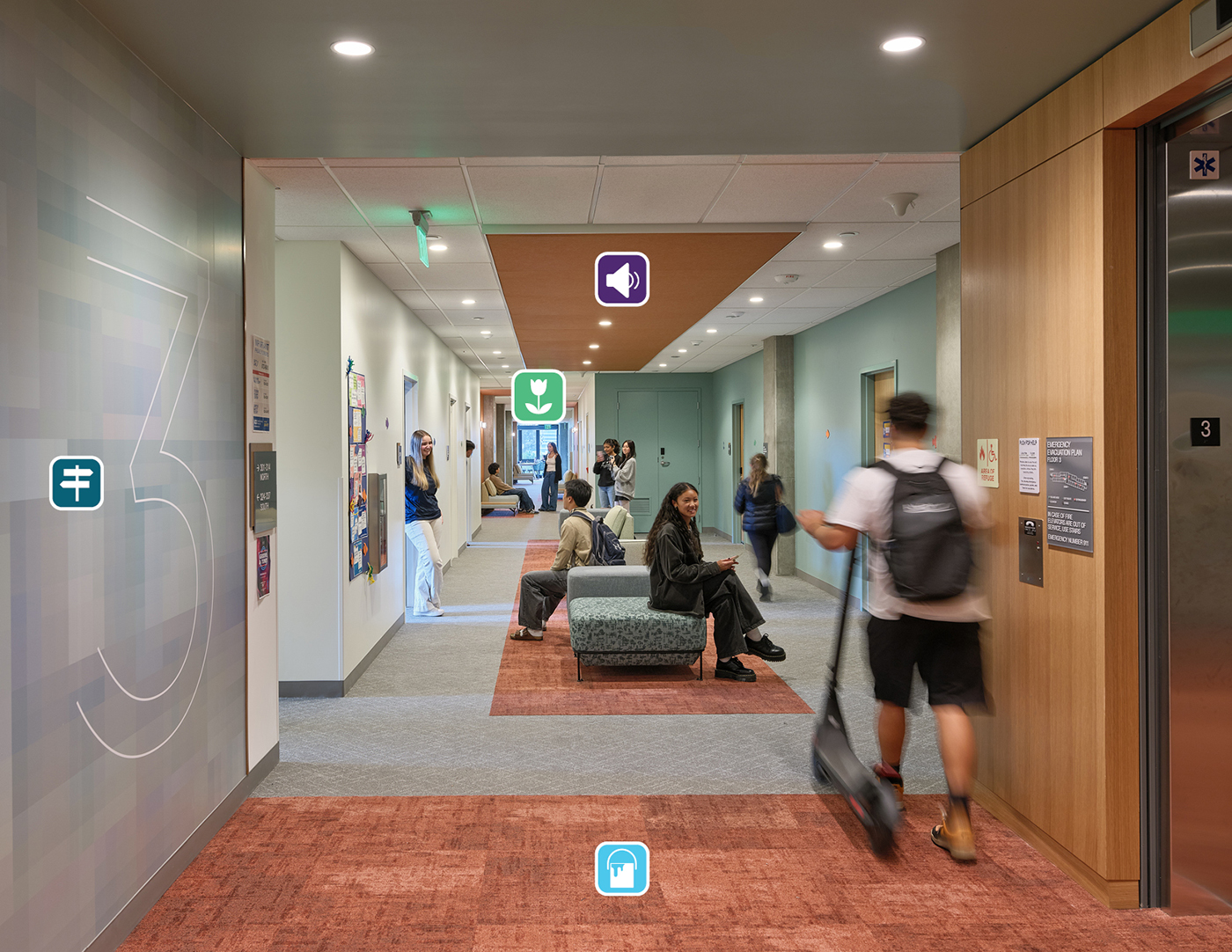
At Georgia Tech Peterson Residence Hall, belonging served as the primary design driver from the earliest stages of planning. Rather than viewing student housing as a collection of bedrooms, the project is organized to create opportunities for connection, choice and community formation. The residence hall is structured as a series of smaller residential neighborhoods, each anchored by shared gathering spaces that encourage everyday interactions among students. These communal hubs are intentionally paired with a range of quieter settings, recognizing that wellbeing depends on balancing social engagement with opportunities for privacy, reflection and focused study.
Design strategies throughout the building support students’ transition to campus life. Increased privacy in bedrooms and bathrooms, flexible common areas, accessible facilities and gender-inclusive amenities help students feel comfortable and supported as individuals. Clear circulation, visible community spaces and opportunities for informal encounters foster a sense of familiarity and connection within a large residential population. By intentionally shaping both social and personal spaces, Peterson Residence Hall demonstrates how the built environment can strengthen belonging, support wellbeing, and create spatial conditions for student success.
A CALL TO ACTION
In January 2026, Mithun partnered with the University of Washington to survey Lander Hall residents about their Sense of Belonging, and received perspectives from approximately 70 students. Their responses reinforce the research: belonging is social-first and space is a facilitator. Students value lounges, commons and nooks. They are drawn to natural light, warm materials (especially wood), and spaces that feel like home. They notice when an institution listens.
Belonging cannot be assumed; it must be co-created. Architects and designers must shape the built environment to the student population it serves, in lockstep with university priorities. Every material choice, lighting decision and corridor layout communicates something. When students feel safe, seen and supported, they are more likely to engage, succeed and graduate.
The question is not whether the built environment shapes belonging. It does. The question is whether we will be intentional about it.
Elizabeth MacPherson Hearn is a partner and interior architect at Mithun who brings an interest in physiology and wellbeing to the design of spaces for living, learning, working and connection. Lynn McBride is a Mithun partner and project leader specializing in the creation of academic, housing and dining environments for universities across the nation.
Other Stories:


