|
Subscribe / Renew |
 |
Contact Us |
| ► Subscribe to our Free Weekly Newsletter | |

Construction Bids
| home | Welcome, sign in or click here to subscribe. | login |


 print print  email to a friend email to a friend  reprints add to mydjc reprints add to mydjc |  |

January 17, 2002
| ||
| Category: | Technical Value to the Engineering Profession | |
| Engineer: | KPFF | |
| General contractors: | McCarthy Building Co. | |
| Architects: | Callison | |
| Owner: | Space Needle Corp. | |
| Description: |
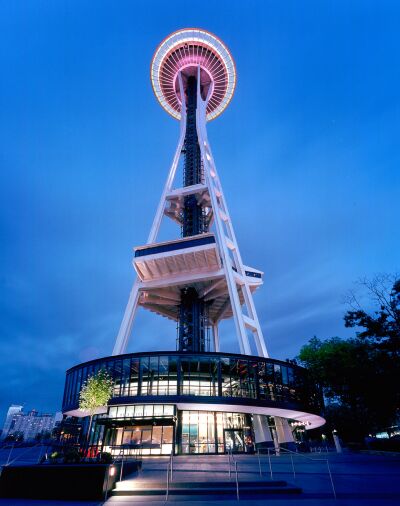
In order to completely surround the existing Space Needle base while keeping the pavilion structurally independent, the new ramp was built like a bridge. As it winds, the ramp narrows from 32 feet to 12 feet wide where it meets the bridge connecting it to the elevator platform. To meet the stringent requirements associated with the Needle’s landmark status, the pavilion’s design called for a structure made almost entirely of glass.
The steel framing, which carries gravity and wind loads, also pulls double duty as an aesthetic element. One-inch diameter rods are positioned diagonally to brace the pavilion’s roof. The rods are welded to the tops of the ramp beams and create a diaphragm for transferring lateral forces while maintaining the transparent appearance of the pavilion’s roof. KPFF’s engineers drew inspiration for the Vierendeel truss system from the numerous curving highway bridges in the Seattle area. The truss is essentially a box with a frame or a slab on each face. There are no diagonal elements. Construction of the pavilion was limited from September to May to avoid the peak season. Additionally, the owner required that the Space Needle remain fully operational throughout the course of the improvements. To achieve this, the design team developed a construction sequence that avoided closures, using a bottom-up approach. | |
Other Stories: