|
Subscribe / Renew |
 |
Contact Us |
| ► Subscribe to our Free Weekly Newsletter | |

Construction Bids
| home | Welcome, sign in or click here to subscribe. | login |


 print print  email to a friend email to a friend  reprints add to mydjc reprints add to mydjc |  |

January 17, 2002
| ||
| Category: | Structural Systems | |
| Engineer: | Skilling Ward Magnusson Barkshire | |
| General Contractors: | Kiewit Construction; Howard S. Wright; Hedreen LLC; and Berschauer Phillips Construction. | |
| Architects: | LMN, MulvannyG2 and Callison | |
| Owner: | Washington State Convention and Trade Center | |
| Description: |
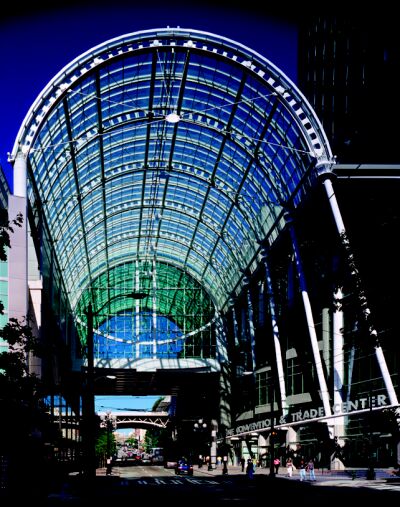
The complex project includes 105,000 square feet of exhibition space, the 435-room Elliott Grand Hyatt Hotel, 319,000 square feet of office space, new convention center entrance, retail space, museum and restaurants.
Skilling is the first firm to use displacement-based seismic design methodology, used in the hotel tower. The system increases building safety and significantly reduces construction cost by eliminating the need for a secondary moment frame for buildings over 240 feet. The result is increased seismic safety, and a savings of $1.50 per square foot over conventional design. For the canopy, a floating isolation system was developed using a circular Teflon and stainless steel sliding bearing plate assembly. The canopy was rigidly fixed to the new convention center on the north side of the street and floats on slide bearings where it is attached to the existing convention center and office building to the south. In addition, the office tower uses a unique composite core system developed by Skilling. The system, featuring a core of steel pipes filled with 10,000-psi high-strength concrete, dramatically reduces steel tonnage and lowers construction cost. On this office tower, the system eliminated 40 percent of the steel that would be required in a conventional design. “The convention center stood out in almost every way,” said juror Alan Coburn. “It really captured the context of the neighborhood in which it was being built, and integrated it into the design. It had a great deal of functionality associated with its spaces.” Juror Steve Arai called it “one of the most highly complex projects that I’ve reviewed, or encountered. It was such an unusual mix of public and private projects, and a varying program.” | |
Other Stories: