 |
Subscribe / Renew |
 |
Contact Us |
| ► Subscribe to our Free Weekly Newsletter | |

Construction Bids
| home | Welcome, sign in or click here to subscribe. | login |


 print  email to a friend  reprints add to mydjc |  |
 |
November 19, 2026

Larsen
|

Desrosiers
|

Jenkins
|
For decades, a stretch of waterfront on the east side of Tacoma’s Thea Foss Waterway sat largely fallow, a remnant of the city’s industrial past. The property once supported large wood-products operations, including plywood and door manufacturing. The waterway itself had undergone a Superfund cleanup, but contamination remained on the upland property.
The site also carries another, much older history: the area is culturally significant to the Puyallup Tribe of Indians.
Sitting between downtown Tacoma and the industrial Tideflats, the Port of Tacoma property presented an opportunity to realize the port’s vision for a new Maritime Center. The campus includes a port administration building as well as a maritime skills center developed in partnership with Tacoma Public Schools for students in the South Sound.
The challenge was making the site ready for that future on a tight development schedule while being attentive to the environmental and cultural complexities. This required approaching remediation and cultural resources as integral components of design. The port and the project team established a baseline of environmental and cultural information and coordinated with the Puyallup Tribe to achieve a design that is sensitive to the cultural landscape.
UNDERSTANDING THE SITE BEFORE COMMITTING
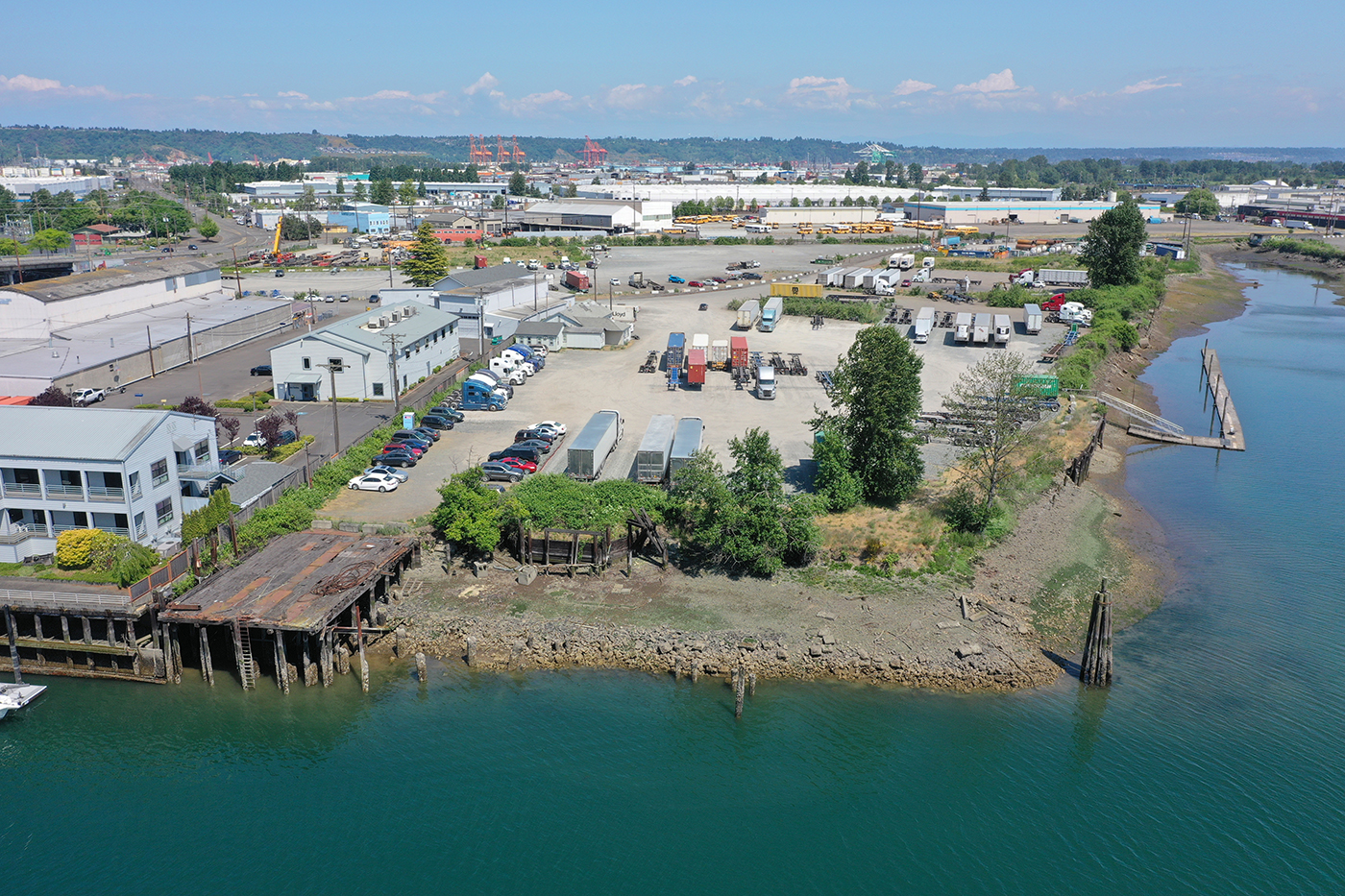
Early work, supported in part by an Integrated Planning Grant from the Washington State Department of Ecology, included environmental testing and cultural resource investigations. These investigations found more extensive contamination than initially anticipated but also indicated that cleanup was feasible.
Cultural resources were another consequential factor. The site was historically part of an island situated between the North Fork and the South Fork of the Puyallup River. This island, within the heart of Puyallup homeland, holds deep spiritual significance to the Puyallup Tribe and is the site of highly sensitive resources and activities. Industrial development in the 19th and 20th centuries reshaped the waterfront, filling the original landform beneath layers of material, shrouding this deeper history.
Working directly with the Puyallup Tribe, the port and project team investigated these conditions and determined how to proceed while advising on design considerations to avoid the most culturally sensitive areas. Early intensive consultation and information gave the port enough confidence to move ahead with the site. The Port’s elected commissioners and executive director consulted with Tribal leadership throughout the project’s design and construction.
This helped establish an important principle that carried throughout the project: addressing environmental cleanup, cultural resources, permitting and redevelopment as interconnected parts of the same process.
CLEANUP, CONSTRUCTION SCHEDULES ON PARALLEL TRACKS
Conventional cleanups often proceed sequentially through investigation, regulatory review, evaluation of cleanup alternatives, design, procurement and construction. On a complex brownfield remediation, this process can consume years before redevelopment gets underway. Because funding and plans for opening the Maritime Center were already in place, the cleanup schedule needed to keep pace with the development schedule so the project vision could move forward.
To accomplish this, the port and its project partners instead used an accelerated approach that allowed remediation and development activities to move forward together. The primary cleanup activities took approximately six months, while other portions of the work were integrated into the development activities. This schedule was achievable by matching cleanup decisions to the future use of different portions of the property and working closely with regulatory agencies, the Puyallup Tribe and project stakeholders.
A thorough, integrated pre-construction investigation was critical to maintaining that pace. By defining both the extent of contamination and the pre-development native shoreline, the project team had the information needed to make timely cleanup decisions as work progressed.
The design-build delivery model was critical as well. Instead of completing cleanup design, procurement and construction before starting the development process, the team advanced the work concurrently and solved problems as they emerged.
For example, when excavation exposed undocumented remnants of old industrial foundations, some of the site’s most contaminated soil was found in and around that concrete. Anchor QEA engineers, the port and the design-build team were able to resolve these conditions without disrupting the overall timetable. Some of the heavily impacted soil was treated prior to removal to detoxify it and reduce disposal costs.
Permitting presented another potential constraint. Waterfront cleanup and redevelopment projects frequently encounter delays as environmental cleanup approvals get delayed by unrelated aspects of the coming development. Here, the project team worked closely with regulators and city of Tacoma staff to develop a phased permitting approach that expedited the cleanup work and kept the overall project on track.
SUSTAINABILITY BEYOND THE BUILDING
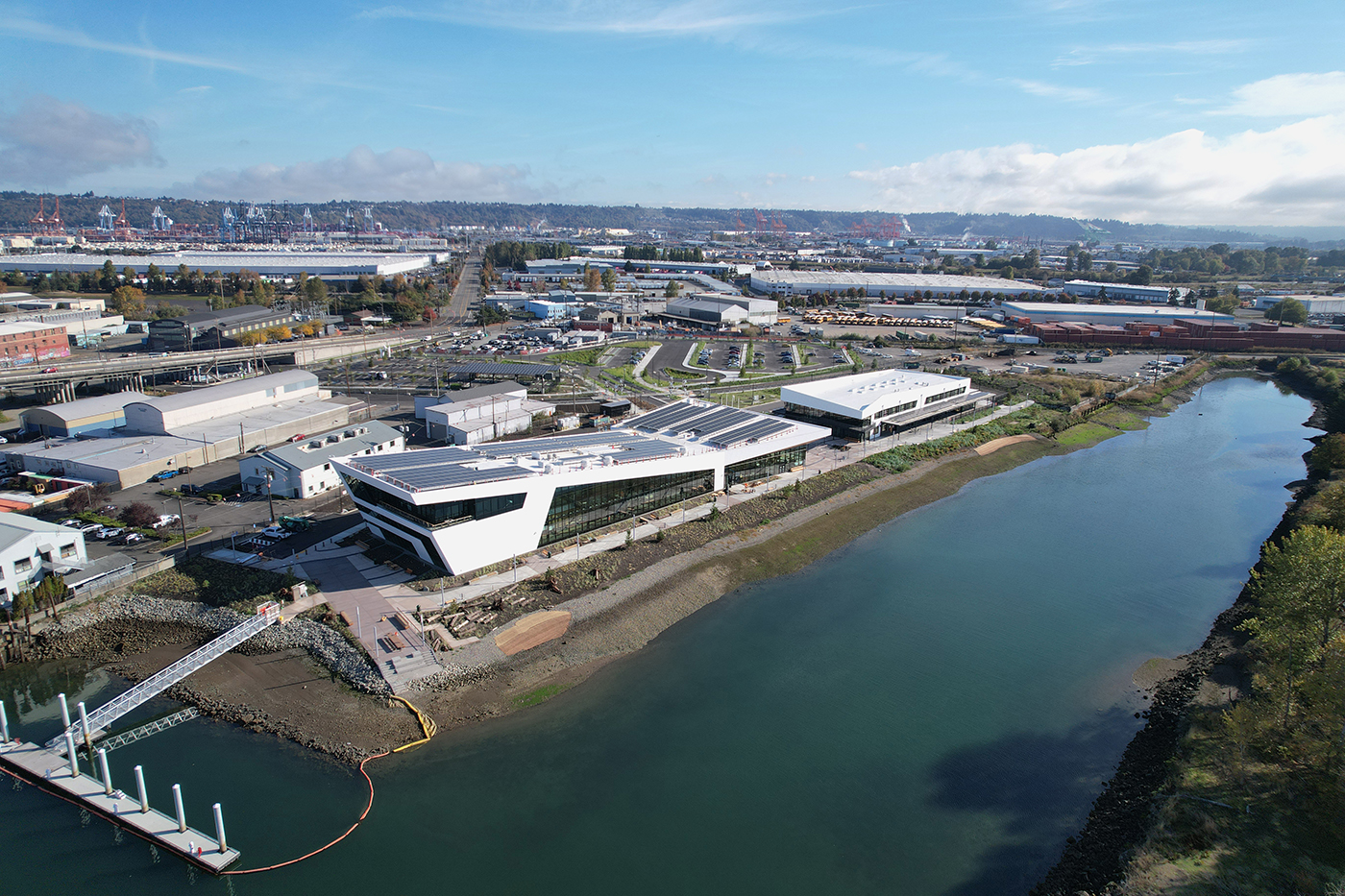
For a sustainable building project, it can be tempting to begin the sustainability discussion at the building itself, including energy use, materials and operating performance. At the Maritime Center, sustainability began before the buildings came out of the ground.
Redeveloping an existing brownfield meant choosing challenging urban land in lieu of an easier greenfield site. The project team designed cleanup around actual future uses rather than simply maximizing excavation and disposal. Materials were beneficially reused within different parts of the project where appropriate. Shoreline soil remediation was coordinated with shoreline restoration activities.
Old creosote-treated docks, pilings, bulkheads and many tons of other industrial debris were removed from more than 1,000 feet of shoreline along the Foss and Wheeler-Osgood waterways, improving the shoreline habitat and readying the area for public access along a new waterway esplanade that opens next spring.
BUILDING TRUST ALONG WITH THE PROJECT
There is another dimension beyond remediation that is harder to quantify: reconciliation. Proactively addressing cultural resource concerns through careful assessment, engagement and design helped shape the relationships necessary to move the project forward.
Although Anchor QEA and the port have a long history of working with the Puyallup Tribe, which played a key role in the cultural resource investigation and communication, the project’s success is due to the approach to engagement.
The port and project team involved the Puyallup Tribe directly in the site investigation and provided updates on a regular basis, discussing what was learned, sharing open questions and uncertainty, and incorporating input. Tribal staff and representatives visited the site, and information was shared as work progressed. Cultural materials identified during site investigations were returned to the Tribe.
Trust grew from a thorough, transparent approach to the work, and by demonstrating that commitments would be honored.
This same transparency extended to the broader community. The port and Tacoma Public Schools did not hide the site’s industrial history, contamination or cultural-resource challenges. These were openly included in the public discussion surrounding the project and are visible in educational signage on site today.
The result was something that isn’t common with brownfield redevelopment: broad community support.
Future phases envision additional shoreline improvements and a waterfront natural area developed in collaboration with the Puyallup Tribe that could help interpret the area’s history and Tribal heritage.
In this way, the Maritime Center is doing more than putting an old industrial property back into productive use. It is also helping define what the transition between downtown Tacoma and its working waterfront can become: a place that acknowledges its environmental and cultural history while remaining connected to the maritime economy that continues to shape the city.
PUTTING BROWNFIELDS BACK TO WORK
For property owners and developers, the larger lesson is that a complicated environmental history does not necessarily make a site undevelopable or incompatible with an aggressive schedule. Unlocking its value may simply require thinking about cleanup differently.
The traditional question is often: What will it take to clean up this property? A better starting point may be: What are we trying to build here, and how does that cleanup fit into future plans?
This distinction influenced decisions throughout the Maritime Center development. The school site needed a highly protective cleanup. Shoreline restoration and cleanup could be done in a coordinated manner. Some materials that required removal from one area were beneficially reused in a different portion of the project.
Permitting accommodated construction that moved on a parallel track. Cultural-resource investigations informed where and how development could occur.
None of this eliminated regulatory requirements. It just helped determine the smartest way to satisfy them.
This is particularly important in the Pacific Northwest, where some of the best-located redevelopment opportunities are also among the most complex — former industrial properties with contamination, infrastructure constraints and histories that can’t simply be excavated away.
On the Maritime Center project, careful planning and dedicated investigations into environmental, regulatory and cultural conditions brought potential challenges to light early enough to shape effective solutions. Technical expertise, creative problem-solving and productive working relationships among the parties helped turn those solutions into reality.
Anchor QEA would like to thank Puyallup Tribe Historic Preservation Department staff Brandon Reynon, Jennifer Keating and Mike Shong, and acknowledge their efforts in consultation, sharing information and insights into the project, and field oversight, all of which were instrumental to the project’s successful consultation throughout the planning and development.
Mark Larsen is a principal scientist, Rebecca Desrosiers, is a principal engineer and Austin Jenkins is a managing cultural resources specialist at Anchor QEA, the environmental team that led the site investigation and strategy, remediation design, permitting and cultural resources for the project.
Other Stories:


