 |
Subscribe / Renew |
 |
Contact Us |
| ► Subscribe to our Free Weekly Newsletter | |

Construction Bids
| home | Welcome, sign in or click here to subscribe. | login |


 print  email to a friend  reprints add to mydjc |  |
 |
November 19, 2026

Abbott
|
Though often viewed as operational or programmatic, composting is directly tied to two of the most urgent climate concerns: greenhouse gas reduction and soil regeneration. In recent years, Berger Partnership has been exploring how the systems we design—soil, planting, stormwater—can take a more active role in climate action. We’ve found that composting is an overlooked source of potential impact.
Composting became a central conversation as part of our work with the Everett Housing Authority’s (EHA) Park District development, where climate performance was a core goal. We began with a question: how could we keep organic waste generated on site — from both residents and landscape maintenance — out of the landfill and in circulation as a soil resource?
The climate case for composting is well-established. When food and yard waste decompose in anaerobic landfill environments, they release methane—a greenhouse gas estimated to be 80 times more potent than carbon dioxide over a 20-year period. While methane dissipates more quickly than CO?, reducing it can have an immediate impact. Project Drawdown is an organization (and a book) engaged in serious, big-picture thinking around climate action. They list food waste reduction and composting among the most effective climate solutions available globally.
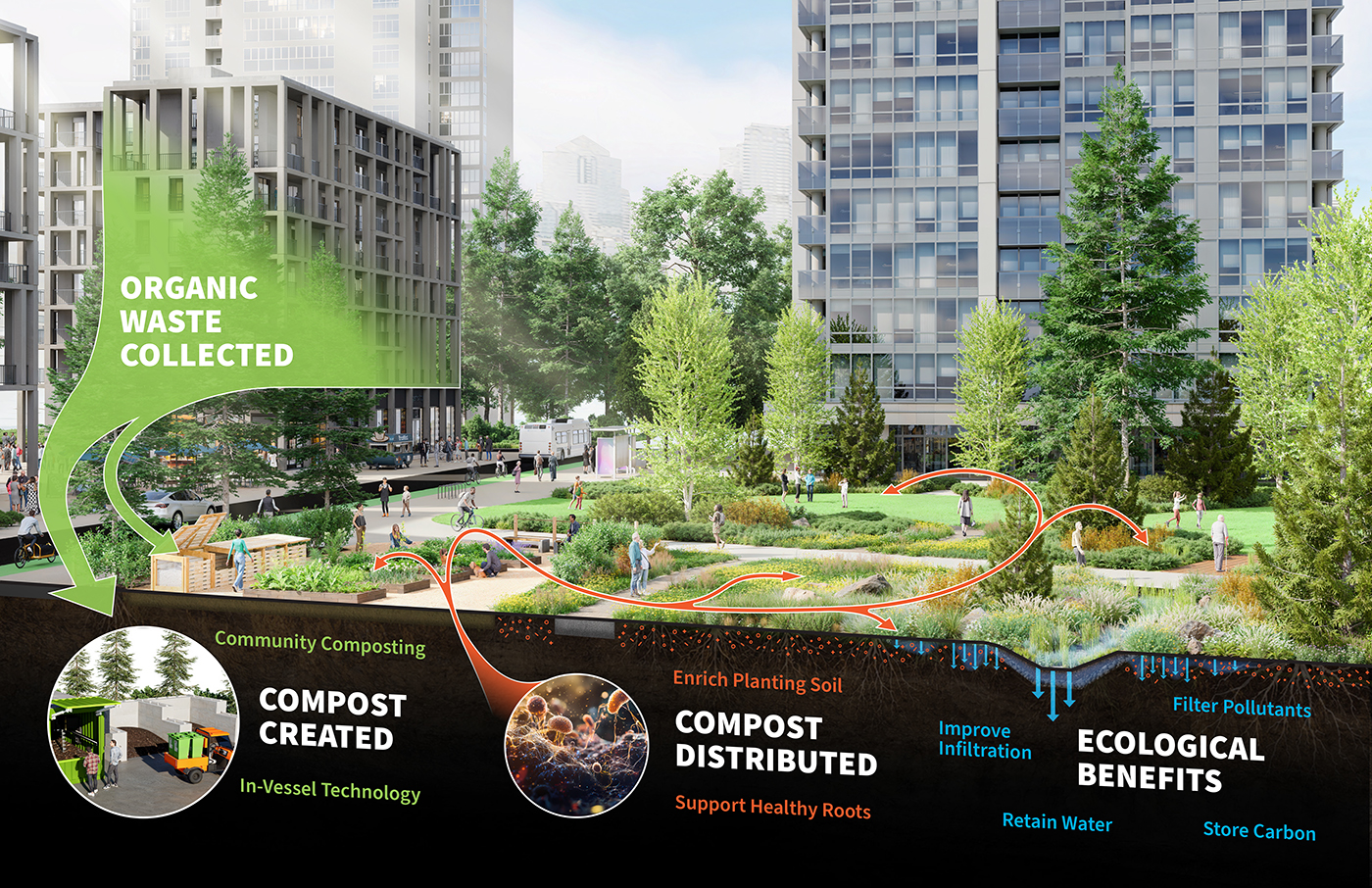
Composting also produces a usable, local soil amendment that reduces the need for manufactured or transported inputs—an ecological and economic benefit for any project that includes plantings or gardens. Compost introduces organic matter, minerals, and diverse microbial communities that support the biological processes underlying healthy soils. Its stable organic matter also increases the soil’s capacity to hold water and retain nutrients, making them available to plants over time. In this way, compost can help build more biologically active, resilient soils while turning an existing waste stream into a resource.
For the Everett project, we researched municipal composting infrastructure and learned about new requirements set out in Washington State’s New Organics Management Law. Passed in phases between 2022-2025, this law is designed to “reduce methane emissions and slow climate change” and is staged to meet a goal of removing 75% of organic waste from Washington landfills by 2030.
In a first, clear step, the law requires organic waste collection to be provided for single-family and nonresidential customers by April 1, 2027. For multifamily projects, the Department of Ecology is requiring nonexempt jurisdictions submitting solid waste plans after July 1, 2026 to establish “programs and a timeline for collection of source separated organic materials from multifamily residences.” Per law, these programs “must include newly constructed or substantially remodeled multifamily residential buildings” (RCW 70A.205.540-5(a)).
By April 1, 2030, further regulations will go into effect: jurisdictions will be required to include food waste in their organic solid waste collection and all persons using other curbside services will be compelled to place “all unwanted organic materials into the separated organic solid waste” RCW 70A.205.540-1(d-e).
The law is phased and nuanced, but it pointed to the need to provide space for compost bins at a minimum. We saw potential to go further.
Working with the client, we proposed a closed-loop system: collecting food scraps and yard waste on site, processing it through a small-scale composting facility, and using the finished compost to enrich soils in the landscape and the project’s community garden.
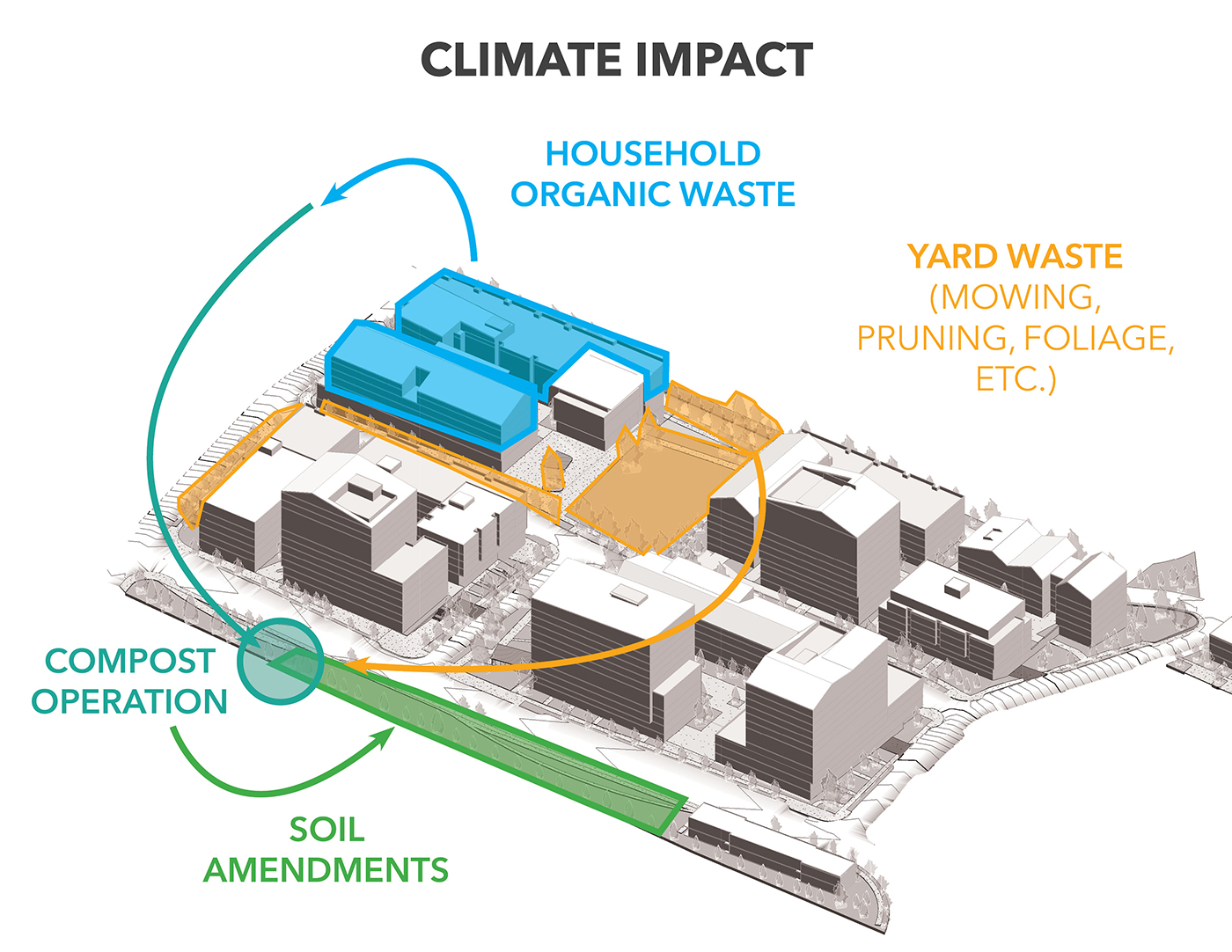
The core action within Project Drawdown’s solution, “Reduce Food Loss and Waste,” is to reduce supply-chain embodied emissions. In other words, there are greenhouse gas emissions associated with producing food (i.e. farm equipment, purchased soil amendments) and with removing organic waste (i.e. vehicles to collect and move waste from one location to another), and wasting less food lowers those emissions.
Having a medium-scaled composting operation within the Everett Housing development would significantly reduce any embodied emissions in moving waste from the development to landfill and compost yard. Instead, organic waste, estimated to be 25-35% of household “trash,” would stay on-site, no more than a block or two away from where the waste was generated.
Using planned unit numbers, average trash production per household (3.9 lbs / day) and 24% assumption for organic waste, we estimated that 3.4 Metric Tons (MT) per month of organic waste could be diverted from the trash to a composting facility on-site.
While staffing concerns arose in conversations, more than 40 Metric Tons (MT) of organic domestic waste (from households) added to yard waste would yield enough compost to potentially sell, suggesting some independent financial viability. After all, compost is a resource. As landscape architects, we specify compost for planting soil, and someone has to buy it.
Layered onto these benefits of reduced embodied energy and the output of compost for landscaping, diverting the organic waste from landfills reduces methane emissions. To take the 3.4 MT estimated per month, that would save the equivalent of 2.5 MT of Carbon emitted per month, or 30 MT of carbon saved per year, the rough equivalent of 450-500 tree seedlings growing for 10 years, or not burning about 3,300 gallons of gasoline (source: EPA metrics).
To support this goal, we integrated composting bins into the building layout at the schematic design phase — an early, simple intervention that ensures composting is logistically feasible.
We also studied operational precedents, including Seattle University’s on-site composting program, to understand staff needs, processing volume, and infrastructure. Although implementation of a full composting facility remains open-ended, the team intentionally designed it for future adaptability. With cultural and financial support, such systems could scale to become operational—and even self-sustaining.
This kind of design work isn’t standard on most projects — especially not affordable housing. But we see it as an essential evolution in practice, particularly for projects where organic waste generation and ongoing landscape management occur at a scale that can support a closed-loop system.
Housing communities, campuses, and other multi-building developments can be especially good candidates, particularly when food service, community gardens, or substantial planted landscapes create both a steady source of compostable material and a productive use for the finished compost. It offers a tangible, site-based intervention that connects global climate goals to everyday resident experience. And because compost is inherently tied to soil systems, its benefits compound; improving plant vitality, supporting stormwater performance, and reducing heat island effect over time.
Our work on composting as a metric for project success reinforces a broader belief: if a project values sustainability, composting — or some form of organic waste recovery—should be considered a baseline design move. When applied at the right time in the design process, these systems are efficient and practical integrations that will optimize the way we use and maintain landscapes.
Christine Abbott is a landscape architect whose interdisciplinary background in architecture, writing, and teaching informs her work on cultural landscapes, housing, commercial projects and parks.
Other Stories:


