 |
Subscribe / Renew |
 |
Contact Us |
| ► Subscribe to our Free Weekly Newsletter | |

Construction Bids
| home | Welcome, sign in or click here to subscribe. | login |


 print print  email to a friend email to a friend  reprints add to mydjc reprints add to mydjc |  |
 |
January 27, 2025
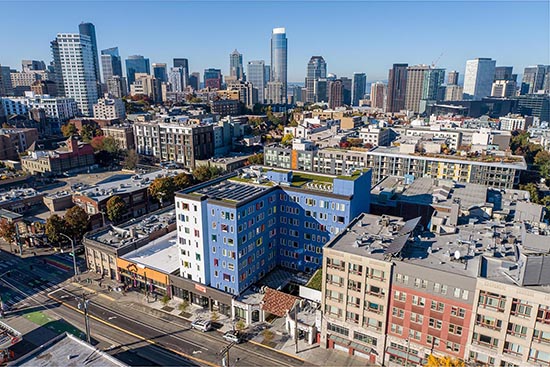
Pride Place
Seattle
Walsh Construction
The Pride Place project is one of the most unique, complex and rewarding projects Walsh has completed. Through integrated design and steadfast collaboration with Community Roots Housing, GenPride, Environmental Works, subconsultants and subcontractors, Walsh was able to exceed client needs around community engagement, cost, durability and performance.
The project was executed on a tight mid-block site with very limited access and included preserving a historic façade of the existing building on the site. Walsh’s team diligently worked with city agencies and subcontractors to lay out a detailed schedule and construction management plan.
This project was designed prior to the current 2018 building code, but Community Roots Housing wanted to explore an all-electric building utilizing Energy Recovery Ventilation (ERV) and heat pump hot water heaters due to incentives that were available at that time. Working with their MEP subs, Walsh provided a cost-benefit analysis to help CRH make their decision to pursue the all-electric path. Once the all-electric system was selected, Walsh’s BIM, layout and QA/QC team played a critical role in reviewing MEP and building enclosure plans and working with subcontractors to successfully install a complex, new system within a crowded, complex building structure.
Walsh worked with CRH to mitigate the impacts of the concrete strike in early 2022, balancing the need to reduce overhead costs while shifting scopes of work forward to minimize overall schedule impacts of the strike.
Walsh prides itself on being a partner to nonprofit owners in responding to community goals, and to being an inclusive and respectful partner during construction. This was especially important for this project which previously housed a historic neighborhood business that was being repurposed to provide housing and services to Seattle’s LGBQT+ community. Specific examples of being responsive to the neighborhood included: frequent communication with Gen Pride and CRH to share with the Capitol Hill community, and a commitment to being an inclusive and tolerant jobsite, especially with regards to homophobia or racism for workers, clients, visitors or people passing by.
Other Stories:


