 |
Subscribe / Renew |
 |
Contact Us |
| ► Subscribe to our Free Weekly Newsletter | |

Construction Bids
| home | Welcome, sign in or click here to subscribe. | login |


 print print  email to a friend email to a friend  reprints add to mydjc reprints add to mydjc |  |
 |
January 27, 2025
Granite
148th Interchange Project
This project included building two new direct access off-ramps at State Route 520 and 148th Ave. N.E., a new cut and cover tunnel, several new side streets, and two new roundabouts in a heavily traveled urban environment adjacent to a local shopping mall and busy intersection. Granite teams worked more than 110,000 hours without a single recordable injury.
The safety of field employees and subcontractors was paramount for this project to succeed. Granite developed exhaustive work plans that anticipated potential hazards, and outlined strategies to mitigate them focusing on the company’s STCKY (Stuff That Can Kill You) hazard recognition program. These plans were not static; they evolved with the project, incorporating feedback, and adapting to new challenges.
Constructing the 148th Interchange required working near live traffic, which presented unique safety challenges. The team focused on positive separation, in the form of temporary concrete barriers, whenever possible, and relied on police officers and internal traffic control teams to manage work zone traffic. Extensive coordination with third-party utilities was required to relocate or protect in place several large utilities within the tunnel footprint.
Platforms like Autodesk Build were utilized to ensure that information was seamlessly shared with field supervisors, enabling real-time updates, better coordination, and swift decision-making, significantly enhancing the team’s ability to maintain a safe and efficient work environment.
GOR1A Data Center
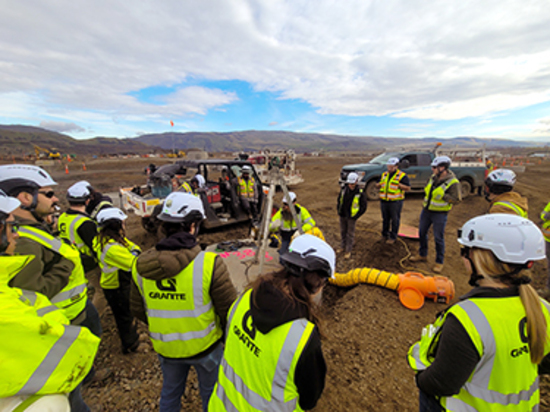
Granite is performing the civil grading and utilities scope for the development of a 100-acre former aluminum smelter site into a new data center campus. Work scope includes drilling and blasting, aggregate crushing, concrete foundation work, grading and paving, all while operating within the requirements of this Superfund site. In addition to the strenuous Superfund site requirements, the team was challenged by the presence of unanticipated asbestos piping and unknown underground structures during deep and complex excavations. Additionally, during construction the GOR1A team conducted confined spaces training on site with a group of young Granite engineers.
Working on a Superfund site introduced the challenge of managing contaminated materials, and abatement procedures required strict adherence to environmental regulations. Comprehensive safety protocols were implemented to mitigate exposure risks, ensuring the safety of crews and the surrounding community. Success on this project was driven by thorough planning and collaboration across multiple departments.
Comprehensive Job Hazard Analyses (JHAs) were developed and reviewed for each scope of work, ensuring all potential risks were addressed in advance. The high standards of the client’s safety program further elevated the knowledge and risk-awareness of crews, requiring innovative safety solutions and fostering a culture of proactive risk management.
The diverse nature of the project scope, coupled with the environmental hazards and high-profile client expectations, required strong collaboration and communication between various teams. Engineers, environmental specialists, safety personnel and construction crews worked together to overcome complex challenges.
McNary Substation
This project involved the complex demolition and replacement of 112 concrete foundations in an active 230 kV switchyard. Given the high-voltage environment, meticulous planning, execution and coordination with the owner were required to ensure the safety of all personnel while maintaining adherence to project schedules and outage windows.
Granite encountered several unique safety challenges that required continuous coordination and communication. Working in an energized switchyard presented significant risks, particularly during excavation and drilling. Safety watchers were deployed to monitor real-time conditions and ensure that work only proceeded in areas that were fully de-energized. The team coordinated with the owners to schedule outages, ensuring that specific areas were de-energized before work began. To stay ahead of potential hazards, the team held regular meetings with site superintendents and safety professionals, adjusting schedules and addressing any upcoming risks, ensuring a proactive approach to safety.
Other Stories:


