 |
Subscribe / Renew |
 |
Contact Us |
| ► Subscribe to our Free Weekly Newsletter | |

Construction Bids
| home | Welcome, sign in or click here to subscribe. | login |


 print print  email to a friend email to a friend  reprints add to mydjc reprints add to mydjc |  |
 |
January 27, 2025
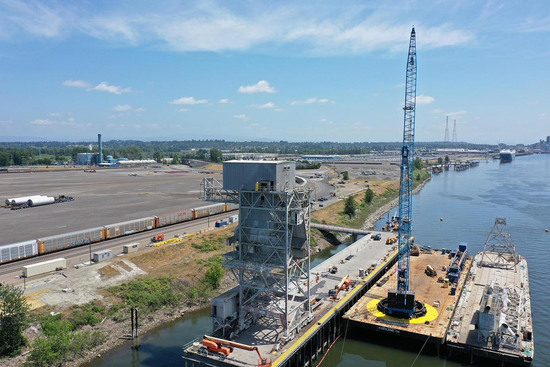
Port of Vancouver Berth 17
Vancouver
Advanced American Construction
Advanced American Construction (AAC) rehabilitated Berth 17 at the Port of Vancouver, transforming it into a modern, high-capacity dock for merchant marine vessels. AAC approached the project with strategic precision, overcoming the distinct challenges of marine construction, and working within an active port environment. From the start, the project required careful logistical planning, including scheduling barge movements and ensuring efficient material deliveries via marine transport. By leveraging strong relationships with suppliers, AAC ensured timely delivery of critical materials like steel piles and mooring bollards, avoiding delays often encountered with land-based transport.
One of the most complex aspects of the project was the safe demolition of the Colby crane and conveyor gallery. Given its intricate design and proximity to the water, AAC used a multi-phase approach to dismantle the crane, cutting and lowering sections to avoid destabilization and ensure no debris entered the adjacent Columbia River. The team used specialized equipment and an innovative containment system to comply with stringent environmental regulations to protect the surrounding marine environment.
As part of the planning process, AAC used drone-based 3D modeling to improve the precision of the demolition. High-resolution aerial images were transformed into a 3D model, which enabled the team to visualize the crane’s structure in detail and develop an efficient demolition strategy. This accelerated the planning process by 30%, allowing for quick adjustments as needed and keeping the project on schedule. The modeling also ensured that debris did not enter the surrounding marine environment during demolition.
Balancing construction activities within the active port added another layer of complexity. Throughout the project, AAC worked closely with the Port of Vancouver to minimize disruptions to port operations. Meticulous planning ensured that materials and heavy machinery could be moved within the restricted space, all while allowing the port to continue its daily operations safely.
The installation of new steel dolphins, equipped with mooring bollards and capstan winches, required precise in-water pile driving within a designated “in-water work window” (IWWW) to minimize impact on fish migration and habitat. AAC utilized advanced pile-driving equipment and total station technology to ensure accurate pile placement. Using 3D CAD modeling to align the batter piles, AAC reduced alignment issues by 25%, saving time and reducing the need for corrections.
These enhancements improved the port’s infrastructure, increasing its capacity for modern maritime operations and facilitating efficient, safe docking. AAC successfully completed the project on time, navigating its inherent complexities with precision.
Other Stories:


