 |
Subscribe / Renew |
 |
Contact Us |
| ► Subscribe to our Free Weekly Newsletter | |

Construction Bids
| home | Welcome, sign in or click here to subscribe. | login |


 print print  email to a friend email to a friend  reprints add to mydjc reprints add to mydjc |  |
 |
January 27, 2025
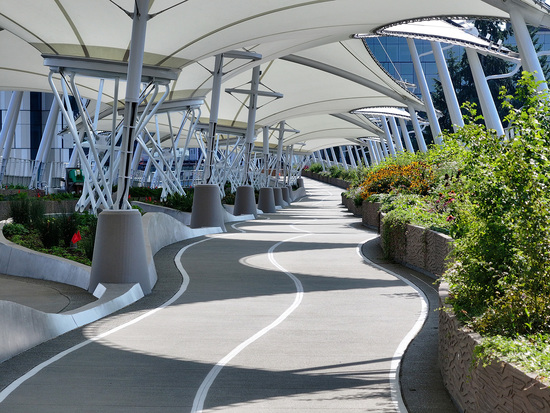
Redmond Technology Station Pedestrian Bridge
Redmond
Kiewit
The Redmond Technology Station Pedestrian Bridge exemplifies the success of public-private partnerships, led by Microsoft and later transferred to the city of Redmond in collaboration with Sound Transit and WSDOT. Spanning state Route 520 in Redmond, the bridge connects Microsoft’s campuses, the regional SR520 bike trail, and Sound Transit’s new light rail station.
Designed with a park-like atmosphere, the bridge features separate paths for pedestrians and cyclists, native plant beds and sustainable elements including a rain gutter system. Stretching over 1,100 feet, the bridge enhances safety with under-canopy lighting and tactile indicators. It provides a direct ramp to the Redmond Technology Station, promoting walking and biking for low-carbon commutes and reducing shuttle and vehicle reliance.
With the bridge footprint on the ground limited, the structure is supported by drilled shafts, with a combination of post-tensioned WF102G girders and trapezoidal tub girders forming the superstructure. To integrate the structural elements with the architectural design, Kiewit utilized Building Information Modeling (BIM) for precise planning, minimizing waste, improving efficiency and visualizing potential challenges before construction began.
The RTS Pedestrian Bridge stands as a testament to the successful collaboration between the design and construction teams. The team ensured that all colors and patterns were well-coordinated, contributing to the bridge’s cohesive and polished appearance, connecting the design languages of Microsoft’s new East Campus, the existing West Campus, and Sound Transit’s Redmond Technology light rail station. The team excelled in executing this complex design with exceptional quality and craftsmanship.
To protect users from the elements, the bridge is covered by an interconnected white tensile fabric canopy supported by architecturally exposed structural steel. The membrane panels alternate between push-up steel masts and pull-down steel elements, which are integral to the rain gardens on the bridge. At night, the bridge is illuminated by light reflected off the underside of the canopy membrane.
By focusing on both functional and aesthetic aspects, the project has delivered a superior user experience. The bridge enhances connectivity, promotes active transportation, and serves as a landmark enriching the community. The team’s exceptional execution of the design has set a new benchmark for quality and craftsmanship in public infrastructure projects.
This partnership has improved mobility, accessibility, and connectivity for thousands of daily users.
Other Stories:


