 |
Subscribe / Renew |
 |
Contact Us |
| ► Subscribe to our Free Weekly Newsletter | |

Construction Bids
| home | Welcome, sign in or click here to subscribe. | login |


 print print  email to a friend email to a friend  reprints add to mydjc reprints add to mydjc |  |
 |
September 26, 2024

Flanagan
|

Rumbaugh
|
Many school districts serve diverse populations with vulnerable students coming from trauma, food insecurity, housing insecurity and other challenges. These students often arrive at school without being ready to learn or to participate in their classes.
For many, especially those in a transient population, or families of recent immigrants or non-English speakers, the school environment is unfamiliar, confusing, or intimidating. School may be a family’s first experience with a civic institution. Often these groups do not feel comfortable in school or represented by the building they are in. As districts consider how to best serve and support these populations, design of the built environment presents options that can change the dynamic for these students and their families.
As the previous Northgate Elementary School in Seattle started work on a replacement facility, it was clear that a “traditional” elementary school building was not the right response for this school. The school community included 11-25% of students experiencing homelessness with 40% transient; 73% of students qualified for free or reduced lunch, 35% were English Language Learners (students spoke 20 languages) with limited English proficiency, and a majority were from traditionally underrepresented groups.
A high percentage of students had Adverse Childhood Experiences (ACEs) — trauma directly or indirectly related to housing instability and living situations. This school community had a high number of students who were furthest from educational justice. Though the statistics sound intimidating, the focus was that these are still kids, with a lifetime of potential and opportunity ahead of them.
|
While the school staff worked hard to foster a sense of welcoming, belonging and connection, many people commented on how the former building felt very institutional and often inhibited staff efforts. The planning and design of the new school presented an opportunity for its community, staff and students to reflect on their shared values and school culture in order to envision an inspirational and restorative school for their specific community.
COMMUNITY-DRIVEN DESIGN WITH A FOCUS ON EQUITY
Many factors can inhibit designing for equity, beginning with who is included in the process. Is it a broad, diverse group that offers differing backgrounds and perspectives? Does it include underrepresented voices? Does it include those who use the building every day? Community input processes often unintentionally create barriers that leave some groups underrepresented.
Issues such as the time of meetings, childcare, or other conflicts inhibit participation. Historically underrepresented people may have prior experiences of their interests being ignored; that would make them question the practicality of spending their time participating in a design process.
Sometimes “community” input is shaped by just a few individuals who have the availability and opportunity to be active in the process. The principal at this school made specific efforts to involve a wide range of voices, and to develop trust that all voices would be heard. To respond to the diverse needs of the school community, the design for the new school was heavily influenced by a collaborative process involving educators, parents and community members. Timeframes and format for input sessions were varied to allow opportunities for more voices.
“WHAT DOES EQUITY LOOK LIKE IN A BUILDING?”
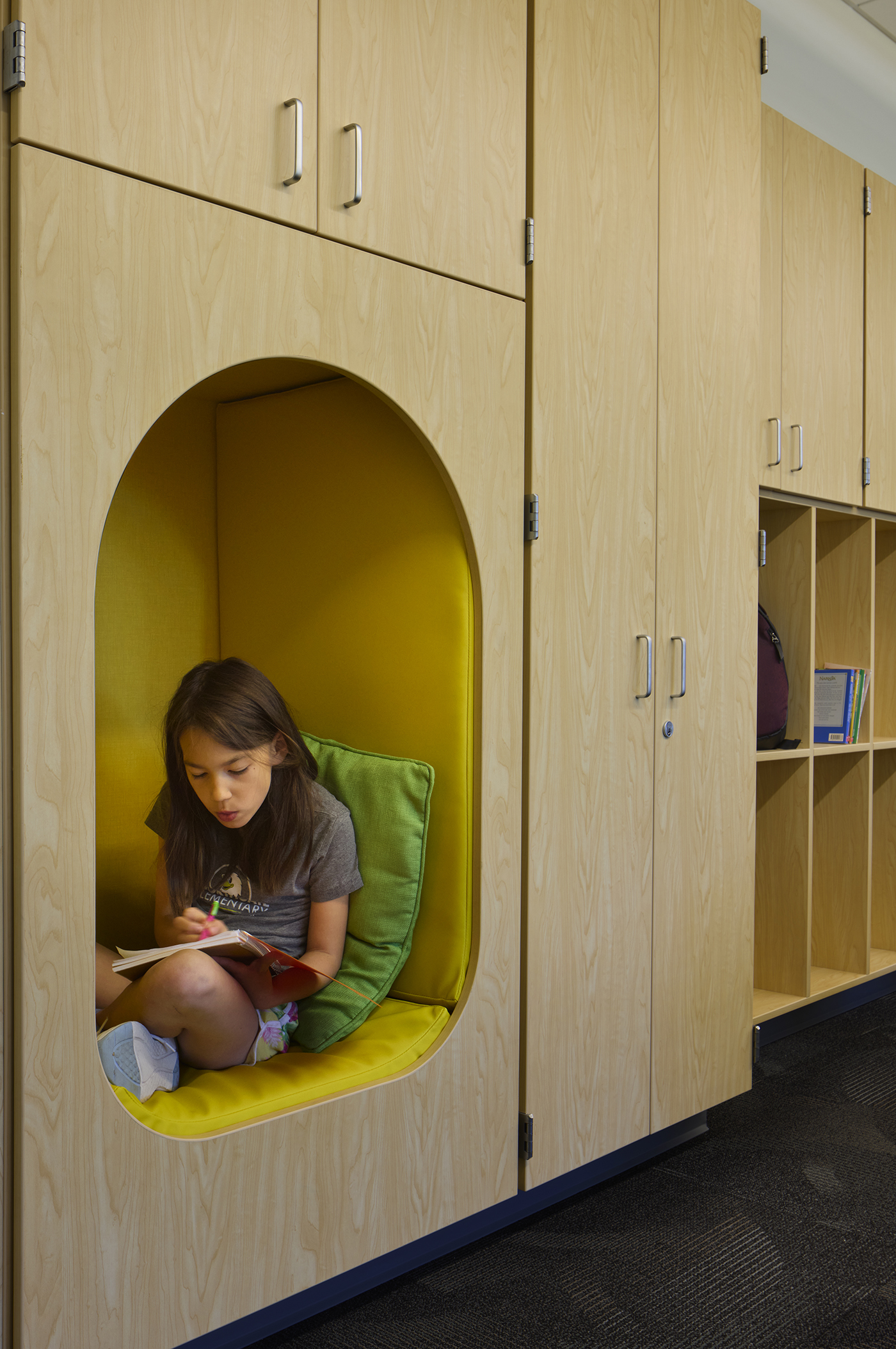
This central guiding question emerged early in the design process. Rather than focusing on equity as a concept, the staff, community and design team talked about the students and families at the school. There was a story shared about a girl who came to school with a blanket. Sometimes during the day, when the energy around her got to be too much, she would pull the blanket over her head and disappear for a while until she felt safe to come out again.
What if the design accommodated a space that provided the sense of protection and calming the blanket gave? What if the building allowed for lower scale interventions before disciplinary action was needed? Stories were shared by parents about how the old building gave a sense of exclusion because the institution, and front office in particular, were felt to be places of discipline rather than support. This led to investigations into how parents could feel more welcome at the school.
AN INSPIRATIONAL AND RESTORATIVE LEARNING ENVIRONMENT
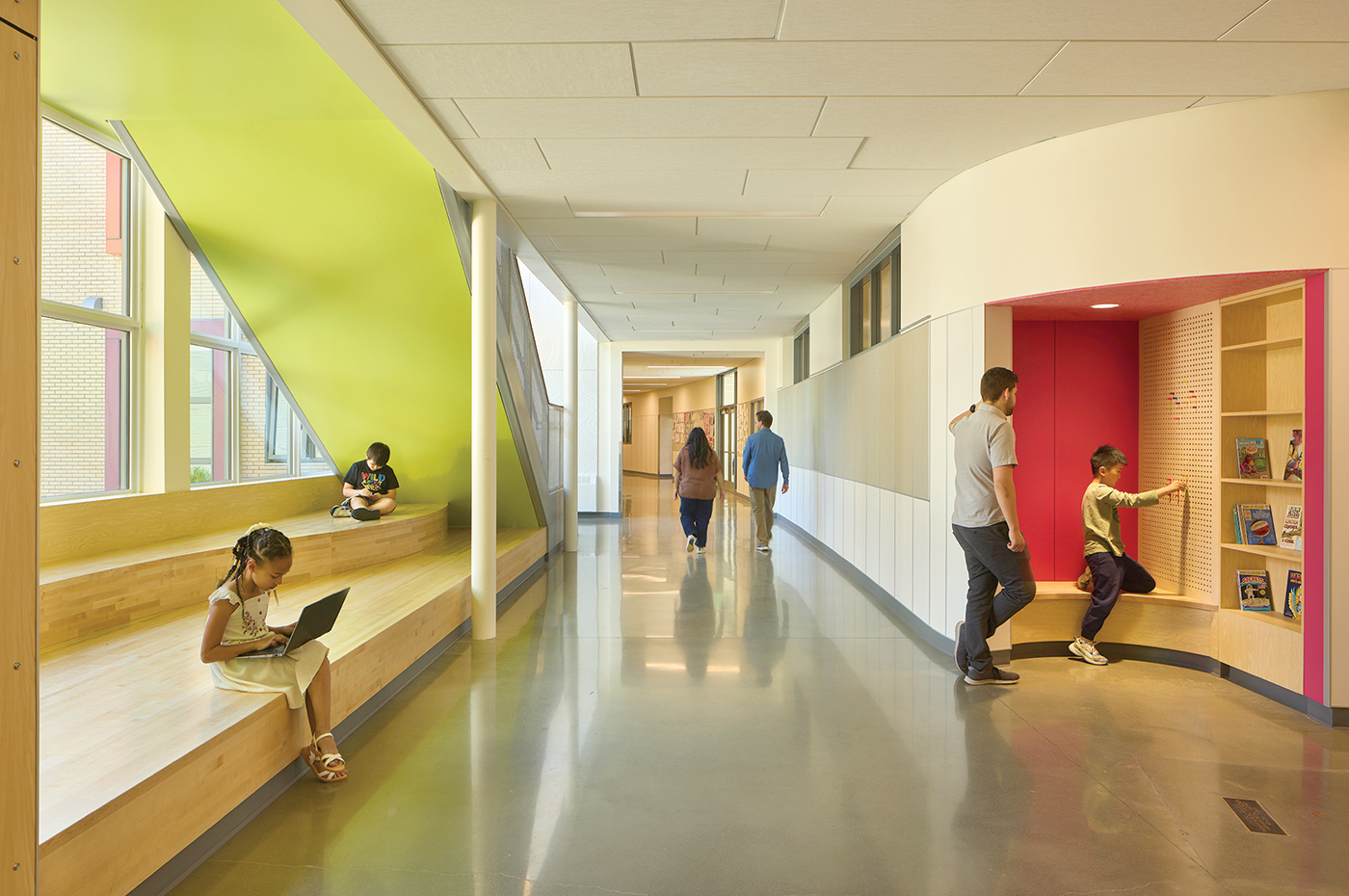
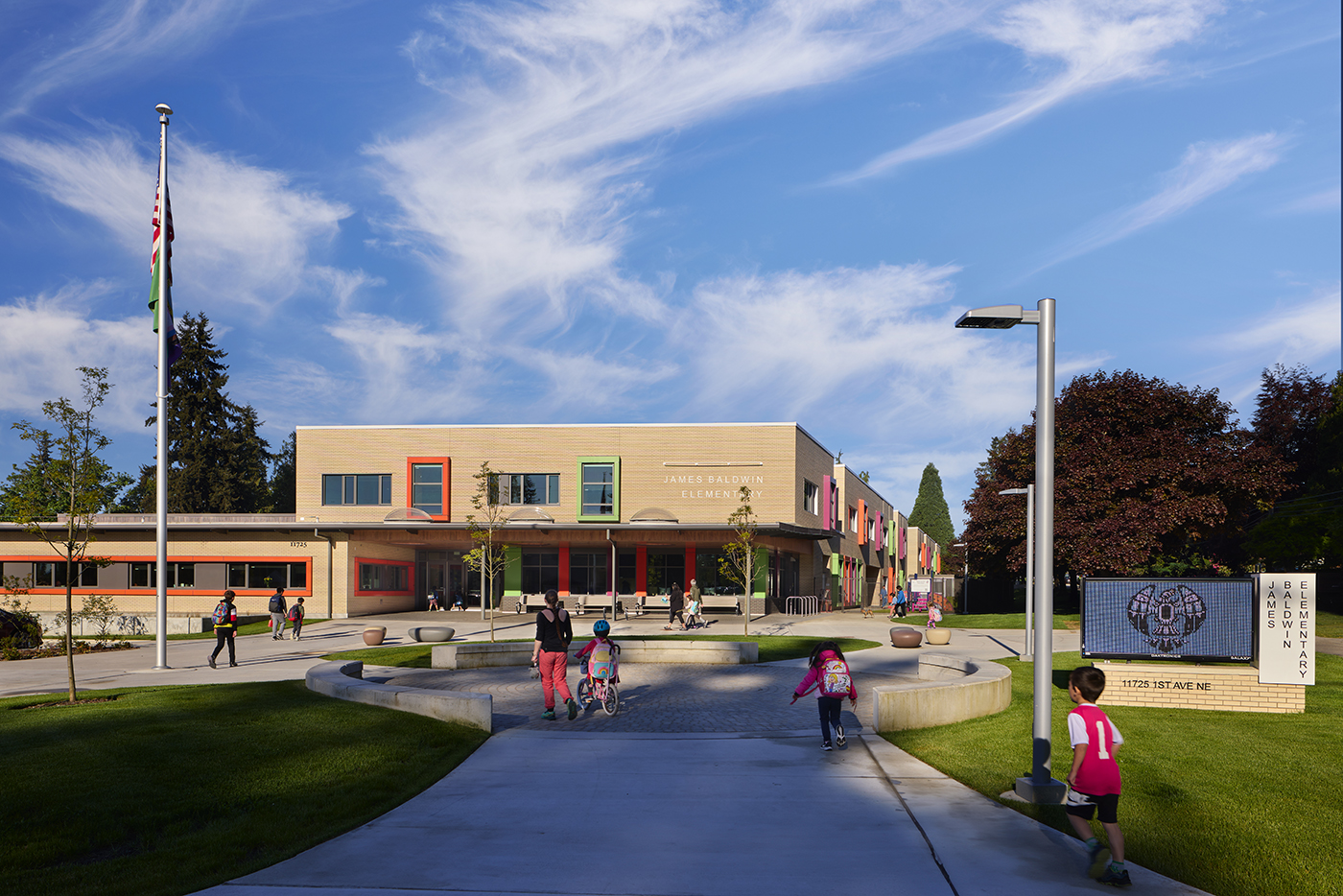
The newly renamed James Baldwin Elementary School is designed with a focus on creating a non-institutional, flexible learning environment that supports vulnerable populations. Features such as “blanket spaces” — comfortable, child-sized cubbies in classrooms and elsewhere — and the use of curved, meandering hallways with frequent openings to open learning commons remove any institutional feel. These also add to a sense of safety and discovery.
The design team and district reviewed research on students experiencing homelessness, which emphasized the need for schools to support the entire family to ensure students were well supported. This led to a Family Room being added to the entry area of the school, separate from the administration, designated as a welcoming space for parents and their children to access resources and support. Flexible to fulfill multiple needs, the room includes storage to provide clothing, food and other items that students and families might need, and a restroom with shower.
The school design takes advantage of research indicating that experiencing nature is restorative. Filled with daylight and views to outdoors, students experience nature from most areas within the school, including all classrooms, and have access to outdoor learning areas. “Mini-libraries” — small alcoves with seating, bookshelves filled with books, and interactive textures or details on the walls — are tucked around edges of shared areas and into the curving hallways throughout the school. These promote literacy, and offer a tapestry of spaces at different scales where students can interact, feel safe and find a spot to call their own.
CULTURALLY RESPONSIVE AND INSPIRATIONAL ARCHITECTURE
In a school that serves students from multiple cultures and diverse backgrounds and experiences, culturally responsive elements are key to fostering a sense of belonging and inspiration among students. The colors used across the school are inspired directly by art from people of color. At the entry to each neighborhood of the school is a different constellation. The names for the constellations are identified as they would be in cultures from around the world, emphasizing that wherever we are from, we all live under the same stars.
A Wall of Luminaries, placed over the entry lobby and along one of the main curving paths on the second floor, celebrates those who have illuminated our world with their contributions to science, art, literature, sport, and through advocating for a more just, equitable, and humane world. Strategically placed mirrors within the photos allow students to see themselves among the luminaries — they become a future luminary.
While each community is unique, we have gained valuable insights into answering, “What does equity look like in a building,” through the design process at James Baldwin Elementary School. Equity, in built form, means creating spaces, fostering experiences, and eliciting feelings in and with the building that support those students who need the most help. A building successful at these things is equitable — a place where everyone can thrive.
Kevin Flanagan is the managing principal of NAC’s Seattle office, and a skilled school planner and designer. Matt Rumbaugh is a principal architect in NAC’s Seattle office, specializing in educational and institutional projects.
Other Stories:


