 |
Subscribe / Renew |
 |
Contact Us |
| ► Subscribe to our Free Weekly Newsletter | |

Construction Bids
| home | Welcome, sign in or click here to subscribe. | login |


 print print  email to a friend email to a friend  reprints add to mydjc reprints add to mydjc |  |
 |
September 26, 2024

Baleiko
|

Moggio
|
The Kitsap and Olympic peninsulas region is currently one of the most underserved regions of Washington state for access to four-year and master’s-level degree programs. Most working-age adults in the region lack the four-year degrees required for the majority of family-wage jobs available. A significant percentage of young people residing in the peninsulas region only have a high school diploma or an associate degree, and thousands of working adults in the area have some college education, but no degree.
To address the educational and economic needs of the Kitsap and Olympic peninsulas, Western Washington University (WWU) worked with The Miller Hull Partnership to develop a pre-design for a new academic building at the Olympic College Poulsbo Campus. Each college and university has a unique approach to supporting its students along a continuum of care, particularly for place-bound and non-traditional students. To craft a successful predesign, architects must collaborate with critical campus voices to make a clear and compelling case to the Legislature for funding. It is essential to set the document and the ultimate project up with flexibility and adaptability, particularly in the program, to weather the uncertainties of funding and economic conditions over time.
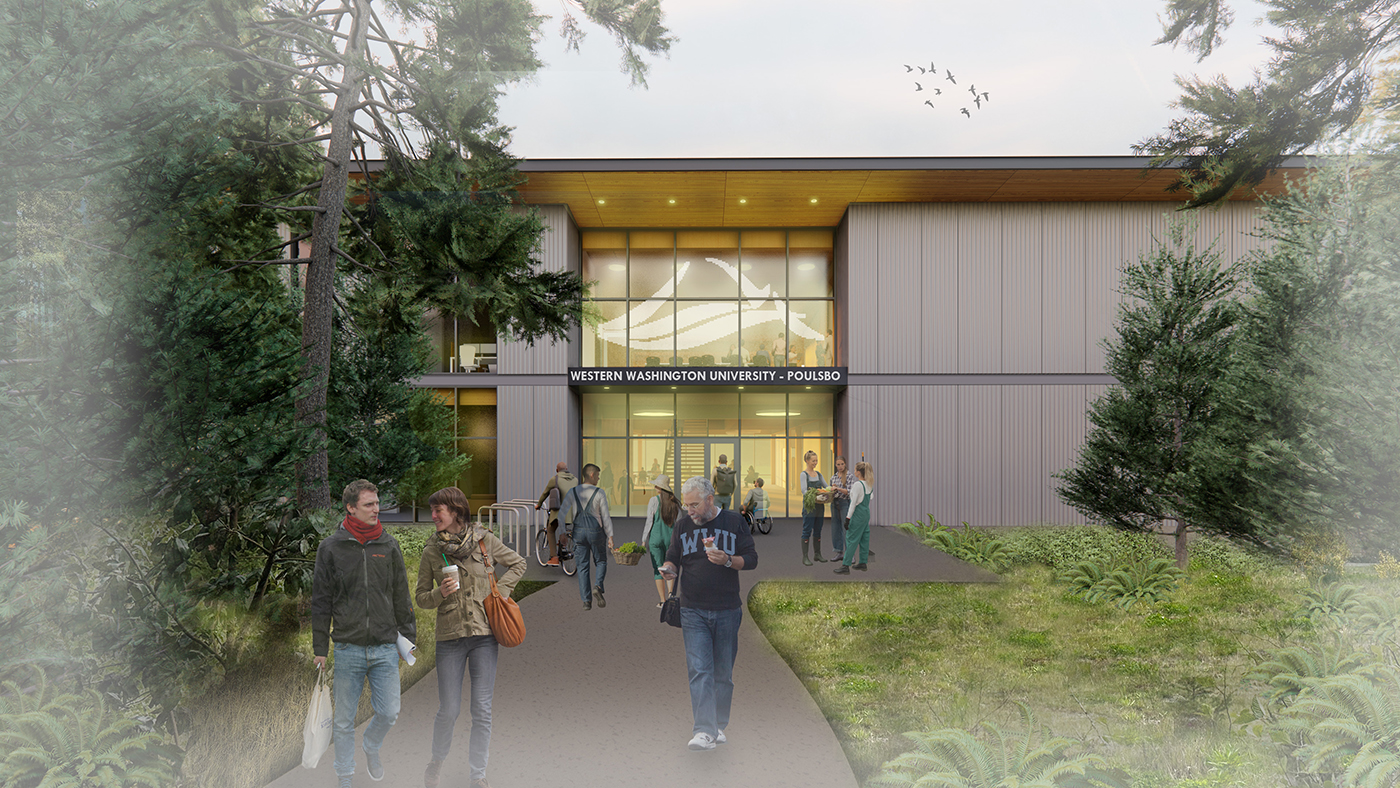
This predesign described a new 44,200-gross-square-foot facility that will provide essential spaces dedicated to hands-on learning, student support and technological research. It will house critical programs in high-demand fields and serve as the new home for WWU’s Cyber Range Poulsbo program, a vital resource for cybersecurity education and research across the state.
By enhancing access to post-secondary education and aligning academic offerings with regional workforce needs, this project is set to transform the local economy and support the state’s goal of increasing credential attainment among adults. This initiative underscores the strategic importance of expanding higher education opportunities to meet students where they are.
SUPPORTING A GROWING REGION
WWU is committed to helping the state of Washington address the diverse educational needs of Washington residents, and to making meaningful progress towards the state’s goal that at least 70 percent of Washington adults ages 25—44 attain a postsecondary credential. As part of this commitment, Western’s strategic plan recognizes the university’s obligation to contribute to future workforce needs by expanding access to four-year degree programs and other credentials to place-bound and non-traditional students in the state.
A 2019 needs assessment funded by the Legislature surveyed educational needs on the Kitsap and Olympic peninsulas, and the feasibility of expanding WWU’s educational programs to meet those needs. The study concluded that a more established four-year university presence and additional degree programs and pathways to credentials are required to better serve regional needs.
PROGRAM NEEDS WITHOUT SPACE
Over the last decade, the state has invested extensively in expanding access to 4-year degree programs on the Kitsap and Olympic peninsulas through 2+2 programs, where graduates of Olympic and Peninsula colleges transfer to WWU to complete their bachelor’s degree. These ‘Western on the Peninsulas’ programs are primarily located in the lone Poulsbo Building of the Olympic College Campus, a 20-acre campus located in North Kitsap County. Current Western on the Peninsulas programs include Cybersecurity, Early Childhood Education, Business Administration, Business and Sustainability, Elementary and Special Education, Environmental Studies, Environmental Science and Multidisciplinary Studies. In 2023, the state further funded the expansion of Western on the Peninsulas programs in Data Science, Industrial Systems and Engineering, Sociology, and Social Work.
CYBER RANGE REACH
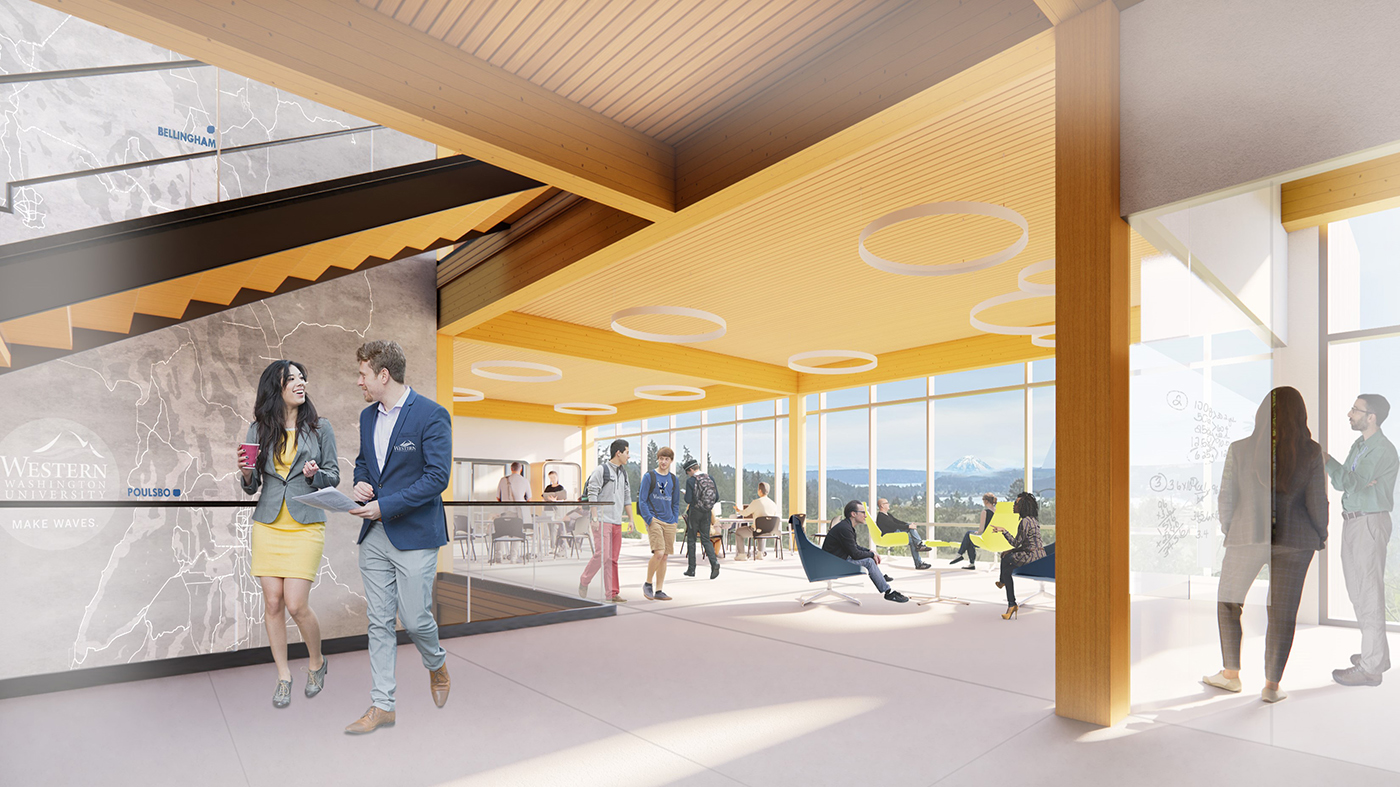
In addition to the expansion of academic offerings, WWU’s Cyber Range, located in the Olympic College Poulsbo Building, has undergone dramatic growth in both size and scope, and now constitutes a major hub of support for cybersecurity education and innovation for the entire state of Washington. Current Range operations support hands-on live experiences for students from twelve colleges and universities and fifteen public school districts across Washington, as well as a major program facilitated by the Department of Homeland Security.
Furthermore, Olympic College is expanding access to workforce opportunities through a multi-phase build-out of Allied Health programs at the Olympic College Campus. The first phase involves the repurposing of the Poulsbo building for several of these programs, limiting the space available for Western on the Peninsulas programs. The combined growth of Western on the Peninsulas and Olympic College programming and the Cyber Range in Poulsbo has resulted in a critical need for a new academic building on the Olympic College Campus.
SUPPORTING NONTRADITIONAL STUDENTS
A new Poulsbo academic building will contribute significantly to WWU’s ability to fulfill its mission to support the population of the Peninsulas with increased access to post-secondary credentials. WWU has worked with the navy, businesses and regional economic development agencies to develop programs that align with local business and industry needs.
Public and private sector employers are seeking to employ qualified individuals who live and will stay in the region, and locals are looking to find employment that will provide a living wage. Based on market research conducted by the Education Advisory Board (EAB) for the expansion of Western on the Peninsulas programs, including estimates on program capacity, WWU anticipates growing its enrollment in existing and new programs by 300 students by Fall 2027.
Having a central hub for these programs at the Poulsbo Campus, where welcoming spaces and convenient student services can be provided, will help student persistence and graduation. Incorporating hands-on learning in specialized class laboratories will also better prepare students to be successful in the regional job market. Over the next decade, Western on the Peninsulas plans to enroll 1000 students in its existing and new degree programs.
A building that considers the population’s unique learning needs will also support the state’s credential attainment goals. Many students work full-time. Some are transitioning from military service, primary caregivers in military families, or connected to civilian contractors tied to military operations in the region. Many are also members of tribal communities. Balancing work and family commitments, and potentially commuting long distances, they seek connection among a non-traditional academic community.
Most also join WWU’s programs after community college, driven by a desire to remain close to home as they seek a swift, targeted education or additional credentials to switch careers or move up within their current job. The creation of multi-purpose, technology-enhanced inclusive spaces, focused on the needs of this population, will provide students with the flexible pathways that allow them to succeed. The new academic building will provide the platform for WWU to support students with diverse needs for access to hands-on learning opportunities, and resources such as career closets, food pantries, and spaces for working adults to gather, connect, and build the networks that support their success.
WWU is focused on serving the needs of the state and the region through access to degree programs on the Kitsap and Olympic peninsulas, primarily located in the Poulsbo Building of Olympic College. Due to program growth, the Cyber Range expansion, and the expansion of Olympic College programming in the current facility, a new academic building is critically needed. This building will support increased enrollment, specialized learning spaces, and the needs of non-traditional students, enhancing opportunities for people to find living wage jobs in the region. Preparing today’s learners for tomorrow’s challenges, the new WWU academic hub at Olympic College Poulsbo Campus is set to redefine education in the Kitsap and Olympic peninsulas.
Ruth Baleiko is a partner at Miller Hull specializing in weaving stakeholder needs into iconic, welcoming public spaces such as higher education, community centers and libraries. Elizabeth Moggio is a principal at Miller Hull who builds consensus with academic stakeholders to create inspiring educational and research spaces.
Other Stories:


