 |
Subscribe / Renew |
 |
Contact Us |
| ► Subscribe to our Free Weekly Newsletter | |

Construction Bids
| home | Welcome, sign in or click here to subscribe. | login |


 print print  email to a friend email to a friend  reprints add to mydjc reprints add to mydjc |  |
 |
September 26, 2024

Bissen
|
Students heading back to school this fall on the Pierce College campus in Puyallup will receive a ‘radical welcome’ from the new Johnson Science Building. The compact, state-of-the-art structure named for former Pierce College Chancellor Michele Johnson offers an inviting and environmentally responsible structure that blends seamlessly with the forested landscape. But it’s not just a new building. It embodies the progressive school’s inclusive philosophy of ‘radical welcoming’ — that in a diverse community of learners, everyone should be made to feel welcome, as innovative and engaged learners not only enrich themselves, but also their local and global communities.
Beyond programming needs, project teams are often asked to consider aspects of client ‘mission, vision, values.’ As the team engaged with academic stakeholders to consider the form and function of their new building, a key question emerged to guide the design. How can a building supporting scientific innovation and excellence tangibly extend the school’s mission, to present a ‘radical welcome’ to science. To draw students to disciplines that have historically been a difficult reach for so many. Also to be an appealing environment for everyone, whether they’re pursuing a STEM degree or drawn just to study and gather. Which design factors contribute to a better academic and social experience, reinforcing the belief that everyone deserves to thrive?
INCLUSIVE ACCESS TO STEM EDUCATION
For nearly 60 years, Pierce College has been a community-based learning institution, nationally awarded for its commitment to student success on multiple campuses across Washington state. They have recognized the need for inclusive and equitable STEM education to provide opportunities for a broad range of students, and to meet ever-increasing demand for a science-based workforce. Reducing barriers of entry is a focus at Pierce on multiple levels — from curriculum and pedagogy development, outreach efforts, funding and its built environment.
The design of this space is not neutral. The collaborative design build team including Absher Construction determined to counteract how science spaces are typically perceived, organized in a way to make science feel less intimidating, especially for students that might be curious, but unsure if they belong. Not an easy feat, when accommodating teaching laboratories and classrooms for physics, chemistry, biology, as well as earth and space sciences. The design also prioritizes the adjacency of science-oriented spaces to approachable and engaging places. While much has changed across colleges and universities to address these dynamics, the Pierce leadership wanted their new building to definitively move the needle toward change supporting inclusive access to STEM education, environmental responsibility, and meaningful placemaking. A strong focus of the design was to ensure the structure extends a ‘radical welcome’ today, and for years to come.
SUPPORTING PEER-TO-PEER COLLABORATION
Peer-to-peer learning is at the heart of the Johnson Science Building. While many spaces have limited access during off hours due to safety requirements, each of the three floors in the 55,000-square-foot structure is organized around open spaces designed for students to workshop ideas, share their thinking, relax and just be together. These spaces are visually linked or next to classrooms and labs, signaling that collaboration is central to science and there’s room for everyone to engage.
The building offers a range of advanced technology resources available to all students throughout the day and in the evening, welcoming not just science students but anyone who needs a place to study or unwind. The intentional use of various types of seating, vibrant colors and plenty of natural light creates a receptive environment.
During the design process, students expressed a desire for ‘perch’ spaces — small, dedicated areas where they could take a quick break without feeling isolated. Responsively, each floor of the building features one or two areas with built-in banquette or bistro-style seating within large open spaces, enabling students to recharge between classes.
ENHANCING FACULTY-STUDENT INTERACTION
An important goal of the building is to increase student access to faculty. The design team was guided by another simple, yet powerful question. How many doors stand between students and faculty? The answer here: as few as possible! Strategically placing faculty offices in small clusters throughout the building adjacent to collaboration spaces makes faculty more visible and accessible to students. It also fosters interdisciplinary connections among faculty members.
MAKING AND EXPERIMENTATION
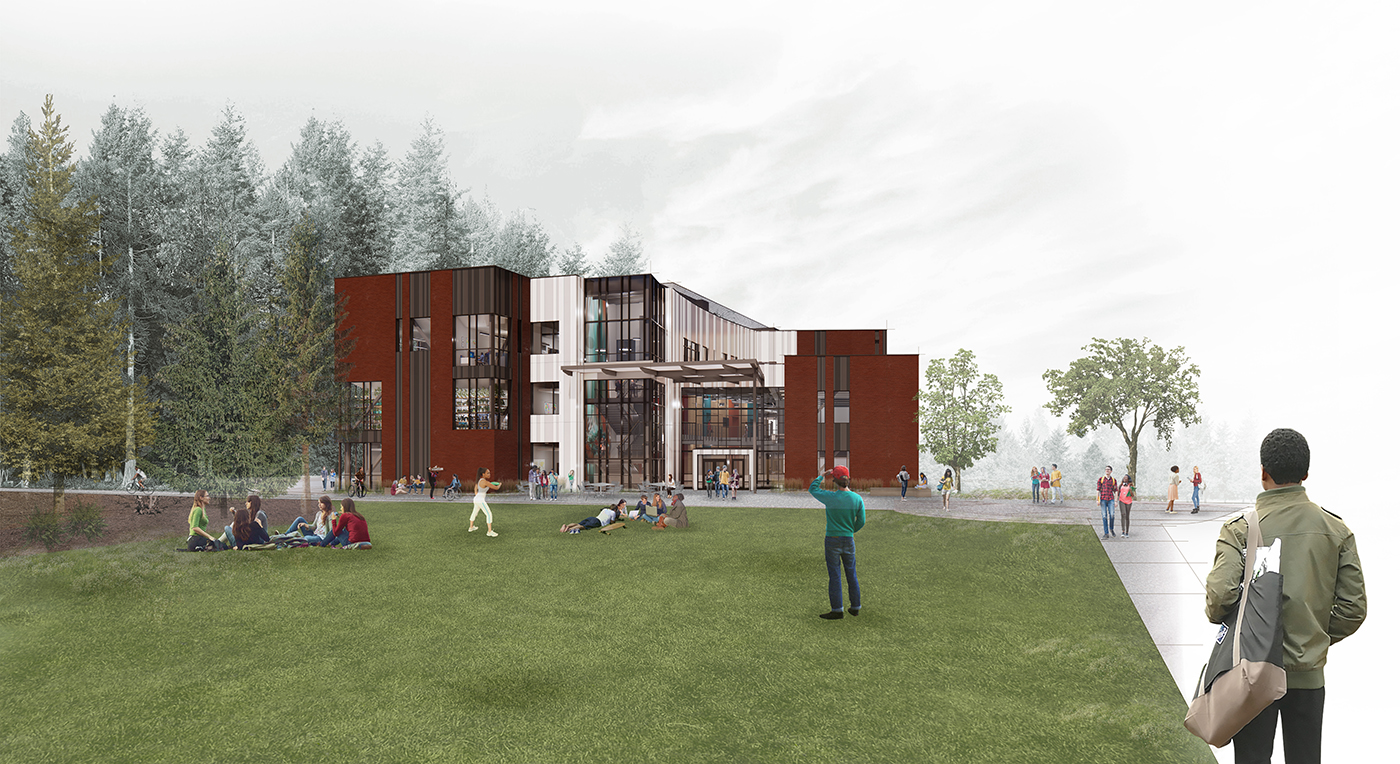
One of the most exciting aspects of the new building is the introduction of 3,000 square feet of maker and fabrication labs, a first for the Puyallup campus and available to all students. Located near the building entrance, the labs present a maker-based gateway into the building. Large windows offer passersby a glimpse into the creative process and hands-on-learning, effectively inviting students from other disciplines to come in and explore. Placing the labs in such a prominent location also sends a clear message that making and experimentation are central to campus culture and innovative science.
ENVIRONMENTAL RESPONSIBILITY AND PLACEMAKING
The Johnson Science Building is not just about what happens inside its walls; but also, about respecting and preserving the incredible natural environment that defines the Puyallup campus. The building was designed through the Progressive Design Build delivery model to meet LEED Gold standards. This fostered the integration of high-performance design that goes beyond traditional benchmarks and greatly reduced the volume of carbon emissions and energy usage from a typical baseline lab building. Its projected EUI of 78 is 61% of a typical lab building, and a notable reduction from the AIA2030 lab baseline EUI of 220. The building is also solar-ready.
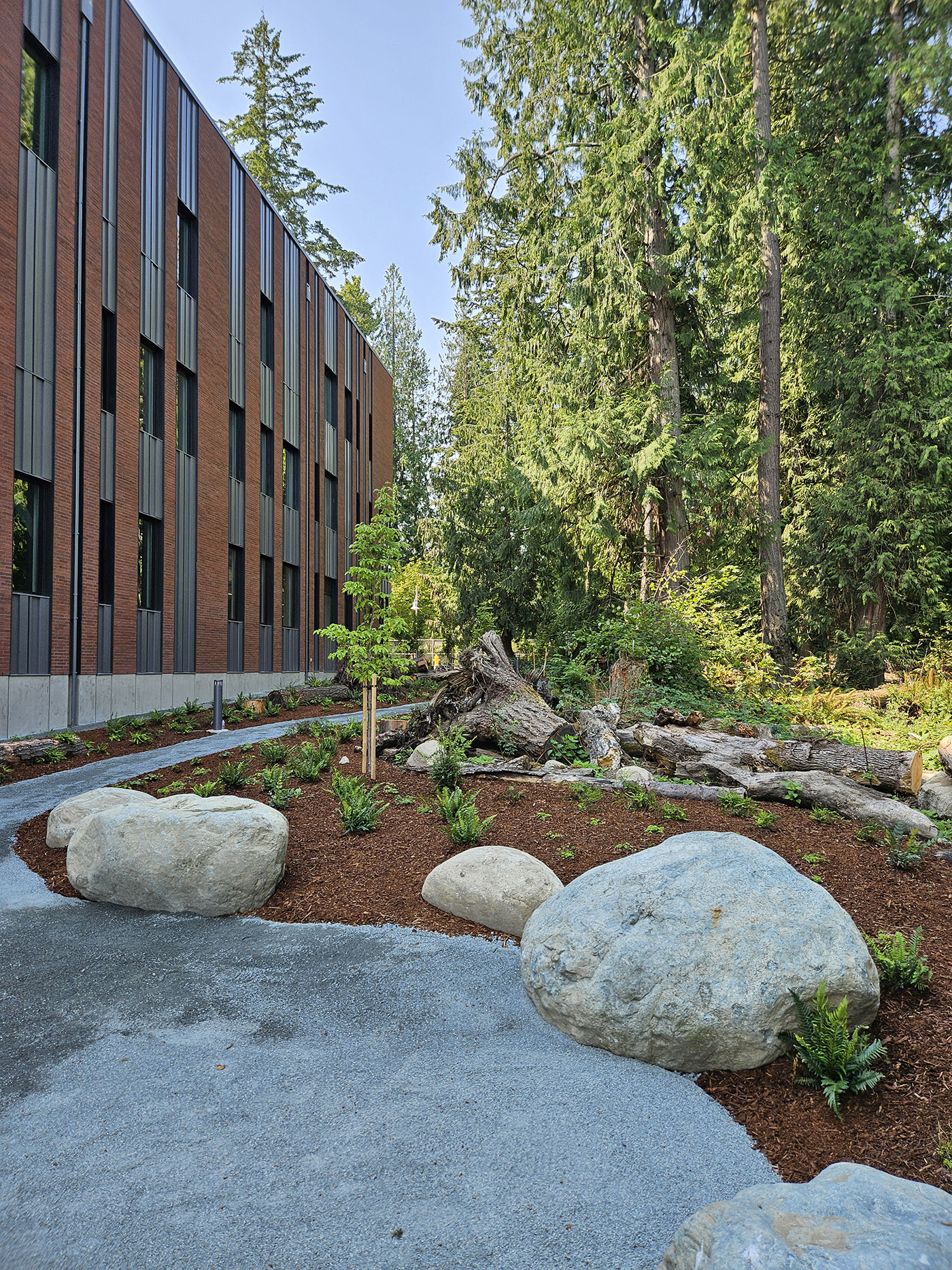
A key design driver was preserving the mature stand of trees and woodland ecology that defines campus character. Minimizing the building’s footprint reduced clearing and grading required and respects the natural landscape, which plays a critical role in stormwater management and water quality. The design also utilizes elements of what was required to be cleared in the new landscaping by incorporating tree stumps for nurse logs, as is found in a natural landscape. This area is accessible as both a living environment and a learning space for studying flora and fauna. The landscape is intended to be directly used by the biology program, as an ecological extension of science studies.
A THOUGHTFUL INVITATION
The Johnson Science Building is conceived as an extension of the campus quad, inviting students in with an open, two-story lobby and maker demonstration area that connects with the outdoor environment. A glass-enclosed stairwell visible from the quad activates the building’s facade with movement throughout the day. The design encourages the use of stairs over elevators and acts as a visual invitation to science activities. A mural inspired by the brilliant colors and the center of petrified wood samples traces up the wall of the stair and informs the interior color scheme. This integration of indoor and outdoor spaces not only leverages the campus’s natural beauty but reinforces that science is a part of everyday life.
The opening of the Johnson Science Building this fall marks the beginning of a new chapter for STEM education at Pierce College, especially for students who accept the ‘radical welcome.’ This building is more than just a place to learn; it’s a place to belong, explore, and grow in a space open and available to all.
Matthew Bissen is a principal and senior design leader at Integrus.
Other Stories:


